Quote
"I have come to view vegetarianism as a standing protest against predation, which is lifes greatest evil. If there were no other argument in its favor, that would be sufficient."
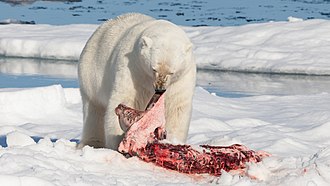 Predation
"And even for the survivors, life involves a constant struggle to find enough food, avoid predators, and overcome sickness and injury for a few brief years (or months) before death comes at the jaws of a predator or the grip of a parasite. Pain is a powerful motivational tool, and evolution has no qualms about using it to maximum effect."
Predation is a biological interaction in which one organism, the predator, kills and eats another organism, its prey. It is one of a family of common feeding behaviours that includes parasitism and micropredation and parasitoidism. It is distinct from scavenging on dead prey, though many predators also scavenge; it overlaps with herbivory, as seed predators and destructive frugivores are predators
"I have come to view vegetarianism as a standing protest against predation, which is lifes greatest evil. If there were no other argument in its favor, that would be sufficient."
Predation"[Predation is] a great evil that a wise or benevolent creator would have avoided."
Predation"Baldner contends that is "arrogant" and "paternalistic" morally to condemn something as definitive of the natural order as predation. However, it is in the nature of morality to devise ideals of a better world and to work toward realizing them. This entails judging this world to be less than ideal and working to change it. One could restrict moral evaluations to the products of human activity, but that would be arbitrary: what makes suffering (prima facie) morally bad is not that it is the result of human activity but that it is suffering. Our commitment to making the world a morally better place impels us to make moral evaluations of the natural order. There need be nothing either arrogant or paternalistic in making and acting on such evaluations, provided we recognize the very limited nature of our understanding and our power to make improvements."
Predation"[H]e saw in Java a plain far as the eye could reach entirely covered with skeletons, and took it for a battlefield; they were, however, merely the skeletons of large turtles, five feet long and three feet broad, and the same height, which come this way out of the sea in order to lay their eggs, and are then attacked by wild dogs , who with their united strength lay them on their backs, strip off their lower armour, that is, the small shell of the stomach, and so devour them alive. But often then a tiger pounces upon the dogs. Now all this misery repeats itself thousands and thousands of times, year out, year in. For this, then, these turtles are born. For whose guilt must they suffer this torment? Where fore the whole scene of horror? To this the only answer is: it is thus that the will to live objectifies itself."
Predation"One simple test of the claim that the pleasure in the world outweighs the pain [...] is to compare the feelings of an animal that is devouring another with those of the animal being devoured."
Predation"Suppose that we could arrange the gradual extinction of carnivorous species, replacing them with new herbivorous ones. Or suppose that we could intervene genetically, so that currently carnivorous species would gradually evolve into herbivorous ones, thereby fulfilling Isaiahs prophecy. If we could bring about the end of predation by one or the other of these means at little cost to ourselves, ought we to do it?"
Predation