Quote
"Sweet exists by convention, bitter by convention, colour by convention; atoms and Void (alone) exist in reality."
 Atomic theory
"And thus Nature will be very conformable to her self and very simple, performing all the great Motions of the heavenly Bodies by the Attraction of Gravity which intercedes those Bodies, and almost all the small ones of their Particles by some other attractive and repelling Powers which intercede the Particles. The Vis inertiæ is a passive Principle by which Bodies persist in their Motion or Rest, receive Motion in proportion to the Force impressing it, and resist as much as they are resisted. By this principle alone there never could have been any Motion in the World. Some other Principle was necessary for putting Bodies into Motion; and now they are in Motion, some other Principle is necessary for conserving the Motion."
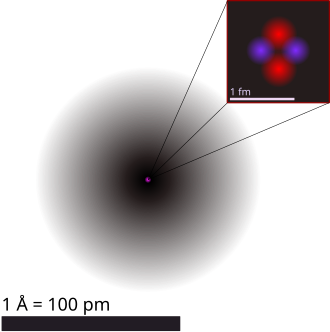
Atomic theory is the scientific theory that matter is composed of particles called atoms. The definition of the word "atom" has changed over the years in response to scientific discoveries. Initially, it referred to a hypothetical fundamental particle of matter, too small to be seen by the naked eye, that could not be divided. Then the definition was refined to being the basic particles of the che
"Sweet exists by convention, bitter by convention, colour by convention; atoms and Void (alone) exist in reality."
Atomic theory"Neither is it impossible that of these minute Particles divers of the smallest and neighbouring ones were here and there associated into minute Masses or Clusters, and did by their Coalitions constitute great store of such little primary Concretions or Masses as were not easily dissipable into such Particles as composd them."
Atomic theory"In 1738 Daniel Bernoulli correctly derived Boyles law by assuming gases consisted of collections of particles that continuously collided with the container walls."
Atomic theory"The problem was that although ideas like statistical mechanics and the kinetic theory worked at the practical level to provide a mathematical description of what was going on, nobody had seen atoms—more to the point, given the technology of the time it was physically impossible to see atoms. This left the door open to for philosophers such as Ernst Mach to argue that the atomic hypothesis was no more than a hypothesis, what is known as a heuristic device, meaning just because things in the macroscopic world behave as if they were made of atoms that doesnt prove that they are... Mach regarded atoms as no more than a convenient fiction, which provided a basis for physicists to make calculations; anything that could not be detected by the human senses, he argued, was not the proper subject of scientific debate. Einstein disagreed, and argued the case for atoms with his friends. He became obsessed with the idea, and determined that if no one else could prove that atoms were real, he would do it himself."
Atomic theory"There is a fundamental error in separating the parts from the whole, the mistake of atomizing what should not be atomized. Unity and complementarity constitute reality."
Atomic theory"I shall not peremptorily deny, that from most of such mixt Bodies as partake either of Animal or Vegetable Nature, there may by the Help of the Fire, be actually obtaind a determinate number (whether Three, Four or Five, or fewer or more) of Substances, worthy of differing Denominations."
Atomic theory