Quote
"Then list’ning hares forsake the rustling woods, And, starting at the frequent noise, escape To the rough stubble and the rushy fen."
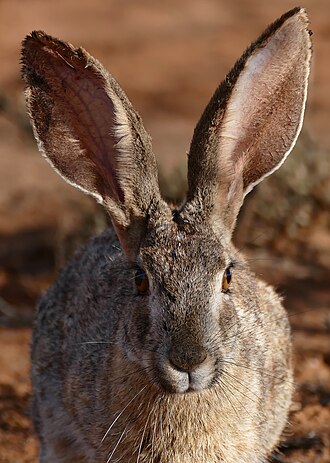 Hare
Hare"And when thou hast on foot the purblind hare, Mark the poor wretch, to overshoot his troubles How he outruns the winds, and with what care He cranks and crosses with a thousand doubles: The many musits through the which he goes Are like a labyrinth to amaze his foes.Sometime he runs among a flock of sheep, To make the cunning hounds mistake their smell, And sometime where earth-delving conies keep, To stop the loud pursuers in their yell, And sometime sorteth with a herd of deer; Danger deviseth shifts; wit waits on fear:For there his smell with others being mingled, The hot scent-snuffing hounds are driven to doubt, Ceasing their clamorous cry till they have singled With much ado the cold fault cleanly out; Then do they spend their mouths: Echo replies, As if another chase were in the skies.By this, poor Wat, far off upon a hill, Stands on his hinder legs with listening ear, To hearken if his foes pursue him still: Anon their loud alarums he doth hear; And now his grief may be compared well To one sore sick that hears the passing-bell.Then shalt thou see the dew-bedabbled wretch Turn, and return, indenting with the way; Each envious briar his weary legs doth scratch, Each shadow makes him stop, each murmur stay: For misery is trodden on by many, And being low never reliev’d by any."
Hares are mammals belonging to the genus Lepus. They are herbivores and live solitarily or in pairs. They nest in depressions in the ground called forms, and their young are able to fend for themselves shortly after birth. The genus includes the largest lagomorphs. Most are fast runners with long, powerful hind legs, and large ears that dissipate body heat. Hare species are native to Africa, Euras
"Then list’ning hares forsake the rustling woods, And, starting at the frequent noise, escape To the rough stubble and the rushy fen."
Hare"Betwixt two ridges of ploughed land sat Wat, Whose body, pressed to th’earth, lay close and squat. His nose upon his two fore-feet close lies, Glaring obliquely with his great grey eyes. His head he always sets against the wind; If turn his tail, his hairs blow up behind And make him to get cold, but he, being wise, Doth keep his coat still down, so warm he lies."
Hare"The hare limp’d trembling through the frozen grass,"
Hare"And, as an hare whom hounds and horns pursue, Pants to the place from whence at first she flew, I still had hopes, my long vexations past, Here to return—and die at home at last."
Hare"Lionel R. Woolner, ed., The Hunting of the Hare (J. A. Allen & Co. Ltd., 1971)"
Hare"As Phœbus would have spoken more, away Penæis stale With fearefull steppes, and left him in the midst of all his tale. And as she ran the meeting windes hir garments backewarde blue, So that hir naked skinne apearde behinde hir as she flue, Hir goodly yellowe golden haire that hangèd loose and slacke, With every puffe of ayre did wave and tosse behinde hir backe. Hir running made hir seeme more fayre, the youthfull God therefore Coulde not abyde to waste his wordes in dalyance any more. But as his love advysèd him he gan to mende his pace, And with the better foote before, the fleeing Nymph to chace. And even as when the greedie Grewnde doth course the sielie Hare, Amiddes the plaine and champion fielde without all covert bare, Both twaine of them doe straine themselves and lay on footemanship, Who may best runne with all his force the tother to outstrip, The t’one for safetie of his lyfe, the tother for his pray, The Grewnde aye prest with open mouth to beare the Hare away, Thrusts forth his snoute and gyrdeth out and at hir loynes doth snatch, As though he would at everie stride betweene his teeth hir latch: Againe in doubt of being caught the Hare aye shrinking slips Upon the sodaine from his Jawes, and from betweene his lips: So farde Apollo and the Mayde: hope made Apollo swift, And feare did make the Mayden fleete devising how to shift."
Hare