Quote
"Its been more than 200 years...The beginning has just started."
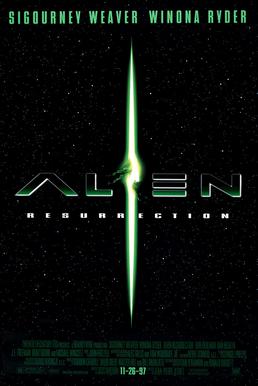 Alien Resurrection
"As almost always with sequels, the "Alien" spawn have gotten dopier as theyve gone along. Yet each has had the saving grace of a distinctive look. "Alien Resurrection" is easily the most visually interesting of all. Credit it to French director Jean-Pierre Jeunet, who imported his surrealistic, horrific ideas direct from "Delicatessen" and the superb "The City of Lost Children." Jeunet blended darkness, heavy metal, repugnantly weird things in specimen vials, an underwater sequence, a feeling of paranoia and an almost determined lack of humanity. And he also brought two of his favorite actors: big Ron Perlman to be a jackbooted bad guy, and Dominique Pinon to get a few laughs as a pipsqueak. Winona Ryder is the biggest new attraction in the series. Her character, Call, is the only soft, humane creature within several light-years of the -- sprawling spaceship Auriga, where the action takes place. Eventually it is revealed that 12 hissing, hungry aliens, products of evil biology experiments, are headed toward Earth. Ryder, arriving with a crew of smugglers, looks almost too doll- like to be hanging around the tough, cynical or maniacal types that populate the films cavernous, clanking world. But her big button black eyes and that intense focus she has at just the right dramatic moment wind up providing the only dollop of humanity. And its much needed."
Alien Resurrection is a 1997 American science fiction horror film directed by Jean-Pierre Jeunet, written by Joss Whedon, and starring Sigourney Weaver and Winona Ryder. It is the fourth installment of the Alien franchise, and was filmed at the 20th Century Fox studios in Los Angeles, California.
"Its been more than 200 years...The beginning has just started."
Alien Resurrection"As a series of action set pieces, the movie is frequently gripping and always highly watchable. In one extended section — geographically reminiscent of “The Poseidon Adventure” with its underwater swim and vertical climb — there’s a real sense of claustrophobia as the beasties pursue their human lunch underwater, and the “Goldfinger”-like demise of the final alien is a typically imaginative tour de force. Editing by Jeunet regular Herve Schneid is especially tight (pic is the shortest of the quartet). Darius Khondji’s lensing, aided by the silver-added ENR printing process, emphasizes deep blacks and soft ochers, with flashes of electric blue supplying visual relief. Nigel Phelps’ production design crosses geometrical sets and clangy brute iron with the Victorian-industrialized look of Jeunet’s own “Lost Children.” Whedon’s script injects some of the rough, testosterone humor of “Aliens” into a story that tries to build on the cross-species subtext of “Alien3.” However, when the movie strays into weirder territory — where, one feels, Jeunet’s heart really lies — there’s a growing feeling of inadequacy. Pic’s interest in Ripley’s split, half-human personality and her maternal bond with the Queen leads to some of the most intriguing — and cheesiest — stuff in the picture, but overall come off more as exotic inserts than fully assimilated sequences. Upside moments include the discovery of a horrific lab (straight out of “Lost Children”) and Ripley’s late-on “embrace” of her fearsome offspring; downside is a laughable Newborn that all but blows the pic’s finale."
Alien Resurrection"To be blunt, the "Alien" movie franchise should have died along with its lead character, Lt. Ellen Ripley, in 1992s "Alien3." Instead, greed has struck again, as producers have drafted a hip director (Jean-Pierre Jeunet, of "Delicatessen" fame) and an even hipper writer (Joss Whedon, creator of TVs "Buffy the Vampire Slayer") in hopes of reviving the film series. But neither man has come up with anything particularly original and instead fall prey to dumb horror conventions with this splattery sequel, which actually gives "Starship Troopers" a run for its money in the gore department."
Alien Resurrection"Jeunet — who is without his collaborator, French comic book artist Marc Caro — seems intent on conveying a weird, creepy atmosphere, but fails to keep the action moving, and he photographs things at perspectives that make it hard to see whats going on. And without a strong director, the actors are all over the place. Dan Hedaya plays things for camp as the station commander, while Weaver is even colder here than she is in "The Ice Storm."
Alien Resurrection"It’s almost as if the pic is afraid to enter the darkened rooms whose doors it keeps opening, though if it had, a truly original movie could have resulted. As it is, the finished film shows many signs of creative push and pull — Whedon’s original script was extensively changed during production — from unexplained ellipses in the plot’s early stages, through dialogue that is surprisingly jokey and unelevated (considering the themes at play), to a storyline that seems unwilling to stray far from the action. In addition, the key relationship in the picture, between femmes Ripley and Call, has little chance to realize its potential and provide a badly needed emotional hook for the audience. In every respect, this is a cold movie that, even at the very end, fails to provide the sense of emotional release that the others in the series all managed to deliver."
Alien Resurrection"Dan Hedaya ~ General Martin Perez"
Alien Resurrection