Quote
"Your ancient home, your auspicious friendship, O Heroes, your wealth is on the banks of the Jahnavi."
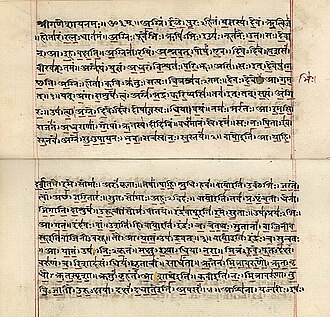 Rigveda
"“As in its original language, we see the roots and shoots of the languages of Greek and Latin, of Celt, Teuton and Slavonian, so the deities, the myths and the religious beliefs and practices of the Veda throw a flood of light upon the religions of all European countries before the introduction of Christianity. As the science of comparative philology could hardly have existed without the study of Sanskrit, so the comparative history of the religions of the world would have been impossible without the study of the Veda.”"
The Rigveda or Rig Veda is an ancient Indian collection of Vedic Sanskrit hymns (suktas) It is one of the four sacred canonical Hindu texts (śruti) known as the Vedas Only one Shakha of the many survive today, namely the Śakalya Shakha Much of the contents contained in the remaining Shakhas are now lost or are not available in the public forum
"Your ancient home, your auspicious friendship, O Heroes, your wealth is on the banks of the Jahnavi."
Rigveda"“On the whole ... the language of the first nine Mandalas must be regarded as homogeneous, inspite of traces of previous dialectal differences... With the tenth Mandala it is a different story. The language here has definitely changed.”"
Rigveda"There is nothing in any of the 1,028 poems that make up the collection to suggest that their authors were incomers to the area that they describe in their poems. Rather the opposite."
Rigveda"Max Mullers dating of the Veda illustrates the arbitrariness involved in the production of theories that are then propagated as "facts" in generations of schoolbooks. Muller, as I have noted, was fully aware of the arbitrary nature of his calculations (which, as Goldstucker pointed out, were based on a "ghost story" written in the twelfth century C.E.): "I ... have repeatedly dwelt on the hypothetical character of the dates" (1892, xiv). As Whitney noted, however: "We have already more than once seen it stated that Muller has ascertained the date of the Vedas to be 1200-1000 B.C." ([1874] 1987, 78). Winternitz also objected that "it became a habit . . . to say that Max Muller had proved 1200-1000 B.C. as the date of the Rg Veda. . . . Strange to say it has been quite forgotten on what a precarious footing [this opinion] stood" ([1907] 1962, 256)."
Rigveda"[The Vedic Gods] “are nearer to the physical phenomena which they represent, than the gods of any other Indo-European mythology”."
Rigveda"There was nothing in the Rgveda to look for a primitive or primarily nomadic society [sic]. . . . Chariots and wagons and boats which occur so frequently in the Rgveda do not agree well with nomadism. Movement of cars presupposes existence of roads and defined routes, which in turn presuppose settlements and regular traffic from point to point. Boats and ships are not floating logs. They presuppose ferry ghats and fixed destinations. . . , there was much in the Rgveda that defied explanation. . . . But instead of reconciling the discordant features, scholars either ignored them or distorted the facts and features. (Singh 1995, 8)"
Rigveda