Quote
"The important thing is to know how to take all things quietly."
M
Michael Faraday"As when on some secluded branch in forest far and wide sits perched an owl, who, full of self-conceit and self-created wisdom, explains, comments, condemns, ordains and order things not understood, yet full of importance still holds forth to stocks and stones around — so sits and scribbles Mike."
Michael Faraday was an English chemist and physicist who contributed vastly to the study of electrochemistry and electromagnetism. His main discoveries include the principles underlying electromagnetic induction, diamagnetism, and electrolysis. Although Faraday received little formal education, as a self-made man, he was one of the most influential scientists in history. It was by his research on
"The important thing is to know how to take all things quietly."
"I shall be with Christ, and that is enough."
"He was little interested mathematics or theory; for example, when his ideas on magnetic fields were extensively developed later by James Clerk Maxwell (1831-1879), Faraday was little concerned with the results. His own scientific career was characterized by simple ideas and simple experiments."
"But still try, for who knows what is possible..."
"Whereas, according to the declaration of that true man of the world Talleyrand, the use of language is to conceal the thoughts; this is to declare in the present instance, when I say I am not able to bear much talking, it means really, and without any mistake, or equivocation, or oblique meaning, or implication, or subterfuge, or omission, that I am not able; being at present rather weak in the head, and able to work no more."
"To estimate the intensity of Faradays scientific power, we cannot do better than read the first and second series of his Researches and compare them...with the whole course of electro-magnetic science since, which has added no new idea to those set forth, but has only verified the truth and scientific value of every one of them."
"The wound is the place where the Light enters you."
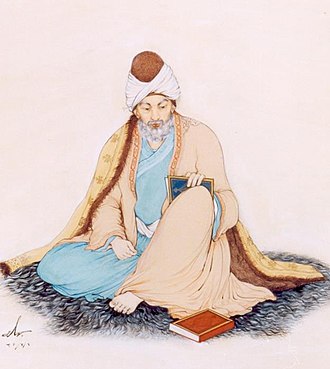 Rumi
Rumi"Be the change that you wish to see in the world."
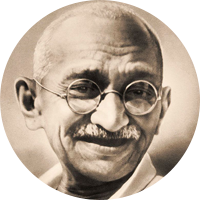 Mahatma Gandhi
"In philosophy equally as in poetry it is the highest and most useful prerogative of genius to produce the strongest impressions of novelty, while it rescues admitted truths from the neglect caused by the very circumstance of their universal admission."
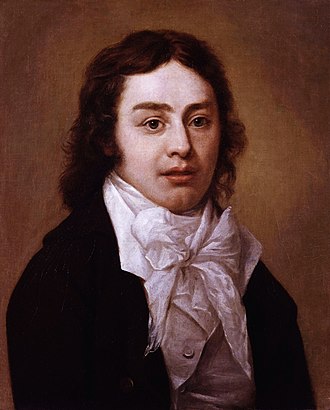 Samuel Taylor Coleridge
"An [hypertext] encyclopaedia will be an overall attempt by the knowledgeable, the learned societies or anyone else, to represent the state-of-the-art in their field. An encyclopaedia will be a living document, as up to date as it can be, instantly accessible at any time. It will contain carefully authored explanations and summaries of the subject, as well as computer-generated indexes of literature. A reference to a paper from the encyclopaedia conveys authority and acceptance by academic society. A measure of a paper’s standing may be conveyed by the number of links it is away from an encyclopaedia."
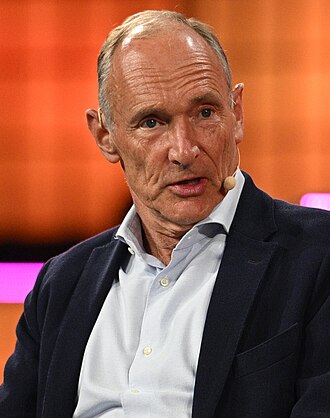 Tim Berners-Lee
"The British intellectual tradition is empirical and liberal, the French is rationalist and aristocratic, and the German is idealist and conservative. ...In the great ontological debate between mind and matter, German philosophy comes down solidly on the side of mind. Its emphasis is intuition as opposed to reason, ideas as opposed to facts."
"To know the mighty works of God, to comprehend His wisdom and majesty and power; to appreciate, in degree, the wonderful workings of His laws, surely all this must be a pleasing and acceptable mode of worship to the Most High, to whom ignorance cannot be more grateful than knowledge."