SHAWORDS

At first [Newcomen] made a double cylinder, using the space between fo — Steam engine

HomeSteam engineQuote
"At first [Newcomen] made a double cylinder, using the space between for condensing water. This was not very satisfactory. The vacuum was secured very slowly and imperfectly. In 1711 they attempted to erect an engine for draining a mine, but failed. The next year they succeeded... but it was slow and ineffective. To operate it, required two men and a boy. The boys work was to alternately open and close the valves to the condensing water and to the boiler. One day the engine made two or three motions quickly and powerfully. Newcomen immediately examined the cylinder and found a small hole, through which a small jet from the water that was on top of the piston to make it steam tight, was spurting into the cylinder. He appreciated the significance... [and] dispensed with the outer water jacket and injected the water for condensation, through a small pipe in the bottom of the cylinder. It... increased the speed of the engine from eight to fifteen strokes a minute, besides getting the advantage of a good vacuum. In 1713 a pump was erected in , and the boy who was hired to open and shut the valves, in an effort to make his work easier, rigged up a contrivance of strings and levers that operated the valves from the motion of the working beam over head. This made the engine automatic and marked another stage in its evolution. This boy, Humphrey Potter... This valve motion was afterward improved by in 1718. This engine... continued to be until the days of Watt..."
Steam engine
Steam engine
Steam engine
author17 quotes

A steam engine is a heat engine that performs mechanical work using steam as its working fluid. The steam engine uses the force produced by steam pressure to push a piston back and forth inside a cylinder. This pushing force can be transformed by a connecting rod and crank into rotational force for work. The term “steam engine” is normally applied to reciprocating engines, although some authoritie

More by Steam engine

View all →
Quote
"Present day knowledge of both the theory and the technique of steam engines has justified Watt in the principles which he laid down, which were that the greater the steam pressure and range of expansion, the greater will be the work obtained from a given weight of steam, and that the cylinder should be kept as hot as the steam which enters it. The main development of the steam engine since his time has consisted in an extension of the range of expansion and in an ever increasing degree of compounding. The separation of the condenser from the cylinder by Watt was followed by the division of the expansion into stages in separate cylinders, finally into four stages in the highest development of the reciprocating engine. The steam turbine carries this subdivision still further, the number of stages included in a reaction turbine of high efficiency being commonly sixty or more."
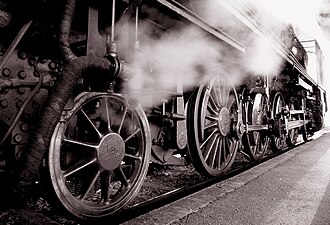
Steam engineSteam engine
Quote
"About the year 1761, or 1762, I tried some experiments on the force of steam in a Papins digester, and formed a species of steam-engine by fixing upon it a syringe, one-third of an inch diameter, with a solid piston, and furnished also with a cock to admit the steam from the digester, or shut it off at pleasure, as well as to open a communication from the inside of the syringe to the open air, by which the steam contained in the syringe might escape. When the communication between the digester and syringe was opened, the steam entered the syringe, and by its action upon the piston raised a considerable weight (15 lbs.) with which it was loaded. When this was raised as high as was thought proper, the communication with the digester was shut, and that with the atmosphere opened; the steam then made its escape, and the weight descended. The operations were repeated, and, though in this experiment the cock was turned by hand, it was easy to see how it could be done by the machine itself, and to make it work with perfect regularity. But I soon relinquished the idea of constructing an engine upon its principle, from being sensible it would be liable to some of the objections against Saverys engine, viz., the danger of bursting the boiler, and the difficulty of making the joints tight, and also that a great part of the power of the steam would be lost, because no vacuum was formed to assist the descent of the piston. I, however, described this engine in the fourth article of the specification of my patent of 1769; and again in the specification of another patent in the year 1784, together with a mode of applying it to the moving of wheel-carriages."
Steam engineSteam engine
Quote
"Iron and heat are, as we know, the supporters, the bases, of the mechanic arts. It is doubtful if there be in England a single industrial establishment of which the existence does not depend on the use of these agents, and which does not freely employ them. To take away to-day from England her steam-engines would be to take away at the same time her coal and iron. It would be to dry up all her sources of wealth, to ruin all on which her prosperity depends, in short, to annihilate that colossal power. The destruction of her navy, which she considers her strongest defence, would perhaps be less fatal."
Steam engineSteam engine
Quote
"Newcomens invention was radically different from that of Savery or any other single person. Papin invented the cylinder and piston as a means for transforming energy into motion. At first he used the explosive force of gunpowder, and later the use of the expansive force of steam, to raise the piston, and then by removing the fire to cause it to fall again. He made no further use of this principle. Savery discovered that the sudden condensation of steam made a vacuum that he utilized to draw up water. His pumps were actually used to drain mines, but were never satisfactory. They had to be placed within the mine to be drained, not over forty feet from the bottom, and then could be used to force up water an additional height of perhaps 100 feet. Beyond this the process must be repeated. It will be noticed that the water to be forced came into direct contact with the steam, which was contained in a solid vessel. In addition tremendous pressures were necessary: as high as 1,200 pounds per square inch were secured, and with the materials for construction at hand frequent and disastrous explosions were the result. Newcomen used Papins cylinder and piston, and Saverys principle of the condensation of steam to produce a vacuum. But unlike Papin he used the expansive force of steam to do his work, and unlike Savery he used a cylinder and piston actuated by alternate expansion and condensation of steam to transform heat into mechanical motion."
Steam engineSteam engine
Quote
"My first essay at making a steam engine was when I was fifteen. I then made a real working; steam-engine, 1 3/4 diameter cylinder, and 8 in. stroke, which not only could act, but really did some useful work; for I made it grind the oil colours which my father required for his painting. Steam engine models, now so common, were exceedingly scarce in those days, and very difficult to be had; and as the demand for them arose, I found it both delightful and profitable to make them; as well as sectional models of steam engines, which I introduced for the purpose of exhibiting the movements of all the parts, both exterior and interior..."
Steam engineSteam engine
Quote
"I have endeavoured to attain this end (viz. the production of a vacuum in the cylinder) in another way. As water has the property of elasticity, when converted into steam by heat, and afterwards of being so completely recondensed by cold, that there does not remain the least appearance of this elasticity, I have thought that it would not be difficult to work machines in which, by means of a moderate heat and at a small cost, water might produce that perfect vacuum which has vainly been sought by means of gunpowder."
Steam engineSteam engine