Quote
"This also is a beautiful circumstance, that they referred every thing to Pythagoras, and called it by his name, and that they did not ascribe to themselves the glory of their own inventions, except very rarely."
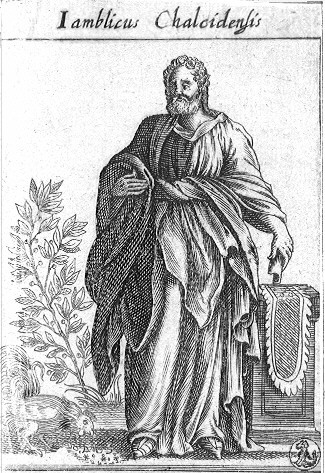 Iamblichus
"Because he practiced justice he gained an easy access to the ears of the Gods; so much so that he had a multitude of disciples, and those who desired learning flocked to him from all parts. And it is hard to decide who among them was the most distinguished, for Sopater the Syrian was of their number, a man who was most eloquent both in his speeches and writings; and Aedesius and Eustathius from Cappadocia; while from Greece came Theodorus and Euphrasius, men of superlative virtue, and a crowd of other men not inferior in their powers of oratory, so that it seemed marvelous that he could satisfy them all; and indeed in his devotion to them all he never spared himself. Occasionally, however, he did perform certain rites alone, apart from his friends and disciples, when he worshipped the Divine Being. But for the most part he conversed with his pupils and was unexacting in his mode of life and of an ancient simplicity. As they drank their wine he used to charm those present by his conversation and filled them as with nectar. And they never ceased to desire this pleasure and never could have too much of it, so that they never gave him any peace; and they appointed the most eloquent among them to represent them, and asked: "O master, most inspired, why do you thus occupy yourself in solitude, instead of sharing with us your more perfect wisdom? Nevertheless a rumor has reached us through your slaves that when you pray to the Gods you soar aloft from the earth more than ten cubits to all appearance; that your body and your garments change to a beautiful golden hue; and presently when your prayer is ended your body becomes as it was before you prayed, and then you come down to earth and associate with us." Iamblichus was not at all inclined to laughter, but he laughed at these remarks. And he answered them thus: "He who thus deluded you was a witty fellow; but the facts are otherwise. For the future however you shall be present at all that goes on."
Iamblichus was a Syrian Arab Neoplatonist philosopher who determined a direction later taken by Neoplatonism. Iamblichus was also the biographer of the Greek mystic, philosopher, and mathematician Pythagoras. In addition to his philosophical contributions, his Protrepticus is important for the study of the sophists because it preserved about ten pages of an otherwise unknown sophist known as the A
"This also is a beautiful circumstance, that they referred every thing to Pythagoras, and called it by his name, and that they did not ascribe to themselves the glory of their own inventions, except very rarely."
Iamblichus"The Pythagoreans thought those who teach for the sake of reward show themselves worse than sculptors, or artists who perform the work sitting. For these, when someone orders wood to make a statue of Hermes, search for wood suited to receive the proper form; while those pretend that they can readily produce the works of virtue from every nature."
Iamblichus"If the potential of every number is in the monad, then the monad would be intelligible number in the strict sense, since it is not yet manifesting anything actual, but everything conceptually together in it."
Iamblichus"The Triad has a special beauty and fairness beyond all numbers, primarily because it is the very first to make actual the potentiality of the Monad — oddness, perfection, proportionality, unification, limit."
Iamblichus"The Pythagoreans called the monad "intellect" because they thought that intellect was akin to the One; for among the virtues, they likened the monad to moral wisdom; for what is correct is one. And they called it "being," "cause of truth," "simple," "paradigm," "order," "concord," "what is equal among the greater and the lesser," "the mean between intensity and slackness," "moderation in plurality," "the instant now in time," and moreover they call it "ship," "chariot," "friend," "life," "happiness."
Iamblichus"It is irreverent to the Gods to give you this demonstration, but for your sakes it shall be done."
Iamblichus