Quote
"A teleology directed to material ends has been substituted for the lust for adventure, variety, and play."
 Teleology
"Because the Systems Age is teleologically oriented, it is preoccupied with systems that are goal-seeking or purposeful, that is, systems that can display choice of either means or ends, or both. It is interested in purely mechanical systems only."
Teleology or finality is a philosophical approach to discussing causality, which explains causes in terms of ends, purposes, or goals.
"A teleology directed to material ends has been substituted for the lust for adventure, variety, and play."
Teleology"If time is treated in modern physics as a dimension on a par with the dimensions of space, why should we a priori exclude the possibility that we are pulled as well as pushed along its axis? The future has, after all, as much or as little reality as the past, and there is nothing logically inconceivable in introducing, as a working hypothesis, an element of finality, supplementary to the element of causality, into our equations. It betrays a great lack of imagination to believe that the concept of "purpose" must necessarily be associated with some anthropomorphic deity."
Teleology"I would say that teleology is theology, and that God is not a "because," but rather an "in order to."
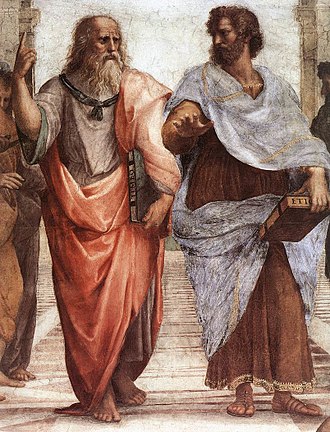
Teleology"[ Aristotle ] totally misrepresents Platos doctrine of "Ideas." ...It is also pertinent to inquire, what is the difference between the "formal cause" of Aristotle and the archetypal ideas of Plato? … Yet Aristotle is forever congratulating himself that he alone has properly treated the "formal" and the "final cause"!"
Teleology"[An] example of the hubris of contemporary science is the rigorous banishment of the word "purpose" from its vocabulary. This is probably an aftermath of the reaction against the animism of Aristotelian physics, where stones accelerated their fall because of their impatience to get home, and against a teleological world-view in which the purpose of the stars was to serve as chronometers for mans profit. From Galileo onward, "final causes" were relegated into the realm of superstition, mechanical causality reigned supreme. ...The mechanistic universe gradually disintegrated, but the mechanistic notion of causality survived until Heisenbergs indeterminacy principle proved its untenability."
Teleology"As we divided natural philosophy in general into the inquiry of causes, and productions of effects: so that part which concerneth the inquiry of causes we do subdivide according to the received and sound division of causes. The one part, which is physic, inquireth and handleth the material and efficient causes; and the other, which is metaphysic, handleth the formal and final causes."
Teleology