Quote
"You can never teach them, except by the slow lesson of habit."
A
Anthony Trollope"Before the reader is introduced to the modest country medical practitioner who is to be the chief personage of the following tale, it will be well that he should be made acquainted with some particulars as to the locality in which, and the neighbours among whom, our doctor followed his profession."
Anthony Trollope was an English novelist and civil servant of the Victorian era. Among the best-known of his 47 novels are two series of six novels each collectively known as the Chronicles of Barsetshire and the Palliser novels, as well as The Way We Live Now. His novels address political, social, and gender issues and other topical matters. He also wrote an autobiography, a book on William Makep
"You can never teach them, except by the slow lesson of habit."
"As will so often be the case when a men has a pen in his hand. It is like a club or sledge-hammer, — in using which, either for defence or attack, a man can hardly measure the strength of the blows he gives."
"There is nothing perhaps so generally consoling to a man as a well-established grievance; a feeling of having been injured, on which his mind can brood from hour to hour, allowing him to plead his own cause in his own court, within his own heart, — and always to plead it successfully."
"There is such a difference between life and theory."
"Satire, though it may exaggerate the vice it lashes, is not justified in creating it in order that it may be lashed."
"Success is the necessary misfortune of life, but it is only to the very unfortunate that it comes early."
"I appeal to all pupils, students and young people, asking you to focus on the horizons that are opening up for you, and which you could only dream of a year ago. Our future will depend on your desire for education and moral values as well as on your entrepreneurial spirit."
"We have created a wealthy society with tens of millions of talented, resourceful individuals who play virtually no role whatsoever as citizens. Bringing these people in — with their networks of influence, their knowledge, and their resources — is the key to creating the capacity for shared intelligence that we need to solve our problems."
 Al Gore
"We are shocked when we see educators, timid before criticism and confused about first principles, betray their trust. And we wonder what can be that philosophy of education which believes that young people can be trained to the duties of citizenship by wrapping their minds in cotton wool."
"I cant read ten pages of Steinbeck without throwing up. I couldnt read the proletarian crap that came out in the 30s; again you had sentimentalism — the poor oppressed workers."
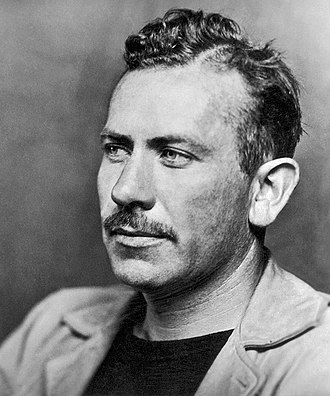 John Steinbeck
"An [hypertext] encyclopaedia will be an overall attempt by the knowledgeable, the learned societies or anyone else, to represent the state-of-the-art in their field. An encyclopaedia will be a living document, as up to date as it can be, instantly accessible at any time. It will contain carefully authored explanations and summaries of the subject, as well as computer-generated indexes of literature. A reference to a paper from the encyclopaedia conveys authority and acceptance by academic society. A measure of a paper’s standing may be conveyed by the number of links it is away from an encyclopaedia."
 Tim Berners-Lee
"One of the first major steps in the direction of modern skepticism came through the victory of Occam over Aquinas in a controversy about language. The statement that modi essendi were replaced by modi significandi et intelligendi, or that ontological referents were abandoned in favor of pragmatic significations, describes broadly the change in philosophy which continues to our time. From Occam to Bacon, from Bacon to Hobbes, and from Hobbes to contemporary semanticists, the progression is clear: ideas become psychological figments, words become useful signs. ... To one completely committed to this realm of becoming, as are the empiricists, the claim to apprehend verities is a sign of . Probably we have here but a highly sophisticated expression of the doctrine that ideals are hallucination and that the only normal, sane person is the healthy extrovert, making instant, instinctive adjustments to the stimuli of the material world."