Quote
"Even though Mendeleev always denied that electrons exist, they later turned out to be vital for ordering the elements in his table."
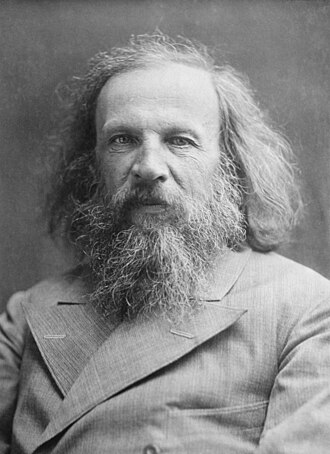 Dmitri Mendeleev
"Despite Mendeleevs initial system being flawed, and the correct theoretical basis of the periodic table not being identified for another 50 years, Mendeleev was able to predict correctly a number of elements that had yet to be identified but which were expected to exist if the repeating periodic structure of the table was correct. These elements included gallium and germanium, whose properties Mendeleev had been able to outline because of their membership in groups of poor metals that included known elements such as aluminum and silicon, respectively (hence Mendeleevs original names of "eka-aluminum" for gallium and "eka-silicon" for germanium). One of the great strengths of a theoretically based classification system, therefore, is that it can predict the existence of yet-to-be identified members of the system or can lead to a reclassification of members that have been misclassified under previous systems."
Dmitri Ivanovich Mendeleev was a Russian chemist known for formulating the periodic law and creating a version of the periodic table of elements. He used the periodic law not only to correct the then-accepted properties of some known elements, such as the valence and atomic weight of uranium, but also to predict the properties of three elements that were yet to be discovered. The synthetic element
"Even though Mendeleev always denied that electrons exist, they later turned out to be vital for ordering the elements in his table."
Dmitri Mendeleev"I have no need of proof. The laws of nature, unlike the laws of grammar, admit of no exception."
Dmitri Mendeleev"1. The elements, if arranged according to their atomic weights, exhibit an evident periodicity of properties. 2. Elements which are similar as regards their chemical properties have atomic weights which are either of nearly the same value (e.g., platinum, iridium, osmium) or which increase regularly (e.g., potassium, rubidium, caesium). 3. The arrangement of the elements, or of groups of elements in the order of their atomic weights corresponds to their so-called valencies as well as, to some extent, to their distinctive chemical properties--as is apparent among other series in that of lithium, beryllium, barium, carbon, nitrogen, oxygen and iron [sic. The printed speech in J. Chem. Soc. says barium and iron. Obviously boron (B) and fluorine (F) are meant. Mendeleevs 1869 paper lists the symbols B and F rather than the names of the elements.--CJG] 4. The elements which are the most widely diffused have small atomic weights. 5. The magnitude of the atomic weight determines the character of the element just as the magnitude of the molecule determines the character of a compound body. 6. We must expect the discovery of many yet unknown elements, for example, elements analogous to aluminium and silicon, whose atomic weight would be between 65 and 75. 7. The atomic weight of an element may sometimes be amended by a knowledge of those of the contiguous elements. Thus, the atomic weight of tellurium must lie between 123 and 126, and cannot be 128. 8. Certain characteristic properties of the elements can be foretold from their atomic weights. ...[R]elations ...exist between the atomic weights of dissimilar elements ...hitherto ...neglected. I believe that the solution of some of the most important problems of our science lies in researches of this kind. To-day, 20 years after the above conclusions were formulated, they may still be considered as expressing the essence of the now well-known periodic law."
Dmitri Mendeleev"Mendeleev noticed that there were regular repeating patterns and similarities between different elements when they were ordered in terms of their atomic weights. Atomic weight was originally calculated from the average mass of one mole of the element relative to hydrogen (though the modern comparison is with carbon-12...). However, even Mendeleev was aware that classification based on atomic weight was flawed; for example, the elements tellurium and iodine occurred in the wrong order on the basis of their atomic weight, with iodine having a lower atomic weight but rightly having the properties of the halogen group (chlorine, fluorine, etc)... Mendeleev therefore decided to reverse the periodic sequence in their case. It was only in the twentieth century, when the structure of the atom based on the protons and the neutrons was identified, that the use of atomic number rather than atomic weight provided the ideal basis for the periodic table classification system. The atomic number of an element refers to its number of protons... Because the chemical properties of an element are determined by the number of negatively charged electrons, which in the non-ionozed form of the element matches the number of protons, there are many elements that have a number of isotopes, that is, have different numbers of neutrons, affecting the atomic weight but not the atomic number. Hence, Mendeleevs tellurium and iodine anomoly turned out to be because the tellurium he had sourced contained a preponderance of a heavier tellurium isotope giving it a greater atomic weight than idodine."
Dmitri Mendeleev"When Mendeleev began teaching at the University, there were 63 known elements, each identified by atomic weights newly determined by Avogadros hypothesis. He had to develop some system of classification. The two basic methods for dividing the elements—into metals and metalloids (nonmetals) or by using the new concept of valency—seemed unhelpful to Mendeleev. He chose to write his own textbook instead and work out the challenges of classification himself."
Dmitri Mendeleev"The work of Mendeleev has lately thrown a new light upon the relations existing between the atomic weights of the elements and their properties. The latter are a function of the atomic weight, which function is periodic. It is not limited to such and such a group of elements, but embraces all of the elementary bodies of chemistry... thus dealing with the most varied and the most profound questions of science... in a word, regard the facts of chemistry from a lofty and comprehensive point of view."
Dmitri Mendeleev