SHAWORDS

During the last six years we have discarded and destroyed much that st — Mikhail Gorbachev

"During the last six years we have discarded and destroyed much that stood in the way of a renewal and transformation of our society. But when society was given freedom it could not recognize itself, for it had lived too long, as it were, "beyond the looking glass". Contradictions and vices rose to the surface, and even blood has been shed, although we have been able to avoid a bloodbath. The logic of reform has clashed with the logic of rejection, and with the logic of impatience which breeds intolerance."
Mikhail Gorbachev
Mikhail Gorbachev
Mikhail Gorbachev
author

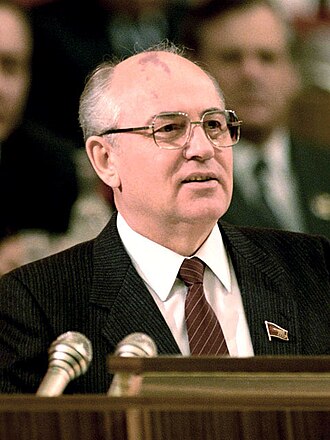
Mikhail Sergeyevich Gorbachev was a Soviet and Russian politician who was the last leader of the Soviet Union from 1985 until the country's dissolution in 1991. He served as General Secretary of the Communist Party from 1985, and additionally as head of state from 1988. Ideologically, he initially adhered to Marxism–Leninism, but moved towards social democracy by the early 1990s.

More by Mikhail Gorbachev

View all →
Quote
"Few Soviet citizens lamented Gorbachëv’s going. His policies had ruined the economy and smashed the state into fragments. His critics showed him no mercy. This was ungenerous of them since without his introduction of glasnost and perestroika they could never have had the opportunity to calumniate him. Abroad, he was better respected. His disinclination to halt the decommunisation of eastern Europe by force was widely admired. His primary role in the ending of the Cold War was rightly esteemed. There had been many times when a different General Secretary would have called upon the armed forces and the KGB and reversed the reform programme. Yet the verdict on him has to take account of his inability to understand the nature of the Soviet order. He had genuinely believed that the USSR could be reformed and still remain communist. He had a passion for a democratic, humanitarian Lenin who had never existed in history."
Mikhail GorbachevMikhail Gorbachev
Quote
"Gorbachev faced a wary Western audience, which he had hoped to woo with vows to end the arms race. Before taking office, during his December 1984 visit to Britain, he had referred to Europe as "a common home... and not a theater of military operations" and had convinced Thatcher that he was a man with whom the West could "do business." But the Reagan administration, facing unexpectedly strong congressional opposition to its military budget, was unreceptive to the new leaders message and intensified its charges of the Soviets untrustworthiness and deplorable human rights record. Nonetheless, in a private message Reagan expressed interest in a summit meeting and assured Gorbachev of his hope to resume the search for "mutual understanding and peaceful development." The US and Soviet leaders met in Geneva in November 1985. At this first Superpower summit in six years, no treaty was signed, but the two-day meeting gave Reagan and Gorbachev an opportunity to evaluate each other and air their differences. Although they jointly declared that "a nuclear war can never be won and must never be fought" and agreed to accelerate work on nuclear arms control, Reagan defended SDI and Gorbachev refused to expand the agenda to include Afghanistan and human rights."
Mikhail GorbachevMikhail Gorbachev
Quote
"Mr. President, you did a great thing. You gave up your post as general secretary of the Soviet Union, but now you have become the president of peace. Because of your wisdom and courage, we now have the possibility to bring world peace. You did the most important, eternal, and beautiful thing for the world. You are the hero of peace who did Gods work. The name that will be remembered forever in the history of Russia will not be "Marx," or "Lenin," or "Stalin." it will be "Mikhail Gorbachev."
Mikhail GorbachevMikhail Gorbachev
Quote
"Having conditioned myself for a new political outlook, I could no longer accept in the old way the multi-colored, patchwork-quilt-like political map of Europe. The continent has known more than its share of wars and tears. It has had enough. Scanning the panorama of this long-suffering land and pondering on the common roots of such a multi-form but essentially common European civilization, I felt with growing acuteness the artificiality and temporariness of the bloc-to-bloc confrontation and the archaic nature of the "iron curtain." That was probably how the idea of a common European home came to my mind, and at the right moment this expression sprang from my tongue by itself."
Mikhail GorbachevMikhail Gorbachev
Quote
"Gorbachevs political views were more audacious. Unlike Deng Xiaoping, who, after the chaos of the Cultural Revolution, was obsessed with stability and ruled out democratic reforms, Gorbachev linked perestroika with a policy of glasnost (openness). Taking aim at the USSRs encrusted ruling party and bureaucracy, Gorbachev adopted a stillborn project of Andropovs to reduce their power by introducing new- even Western- ideas into the Soviet environment and engaging the Soviet population in modernizing the country. He went so far as to authorize the opening of the records of Soviet history, including its darkest moments, which ignited an explosion of criticism reaching back to Lenins rule. To be sure, Gorbachevs purpose was to preserve the communist system by revitalizing it from above, but by combining perestroika with glasnost the Soviet leader risked unleashing forces he was ultimately unable to control. Gorbachev was even more daring in his foreign policy because he believed that the relaxation of international tensions was indispensable to his political reforms at home. Convinced that the Soviet Unions greatest threat was nuclear war but that its huge military budget was unsupportable, he intended to achieve security by scaling down the global rivalry between Moscow and Washington and reviving détente. After assembling a group of like-minded liberal internationalists, among them the new foreign minister, Eduard Shevardnadze, and his foreign policy adviser, Anatoly Chernyaev, Gorbachev boldly embarked on a step-by-step program of reducing the USSRs isolation and reaching out to the other side, which included Western Europe, Japan, and China as well as the United States."
Mikhail GorbachevMikhail Gorbachev