Quote
"The hajj is one of the five essential practices of Islam; when they make the pilgrimage to Mecca, Muslims ritually act out the central principles of their faith."
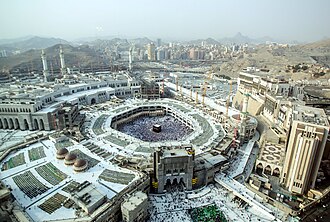 Mecca
Mecca"For centuries, scholars from the four different schools of Islam had taught in the Holy Mosque and crowds of students had traveled from near and far to gather in halaqas, circles of study, around their preferred teachers. The faithful prayed, at slightly different times, behind their imams; there was a prayer station for each school: Shafi’i, Maliki, Hanafi, and Hanbali. When King Abdelaziz took control of Mecca in 1924, the Wahhabi clerics objected to the arrangement that had prevailed so far in the Holy Mosque. If the community of Muslims was one, and the call to prayer was one, why not pray behind one imam? The Wahhabi clerics won the debate, thereby dealing themselves all the power. But there was no rotation or compromise: the sole imam who would lead all five daily prayers in the Holy Mosque came from Wahhabi circles, with all that that entailed in puritanical intolerance. The number of halaqas dwindled rapidly, from several hundred to around thirty-five in the late 1970s. The Sufi sheikh that Sami had consulted that first day of the Mecca attack, Mohammad Alawi al-Maliki, was still drawing crowds, lecturing in his corner of the courtyard of the Holy Mosque, on the chair he had inherited from his father in 1971, the chair that been passed through generations. But few others were able to resist the onslaught of Wahhabi zeal. Harmony could be brought back, Sami thought, only if diversity was allowed to thrive again in the House of God. But this was not how the Al-Sauds would proceed. That was not the deal they had cut with Bin Baz to save their throne."
Mecca, officially Makkah al-Mukarramah, is a city in the Hejazi region of western Saudi Arabia and is the capital of Mecca Province. Mecca is considered the birthplace of Islam and the Islamic prophet Muhammad, as well as being the holiest city in Islam.
"The hajj is one of the five essential practices of Islam; when they make the pilgrimage to Mecca, Muslims ritually act out the central principles of their faith."
Mecca"The House of Saud had used its custodianship of Mecca and Medina to claim leadership of Muslims everywhere, using the pilgrimage as a conduit for its influence around the Muslim world. Wanting to welcome an ever-increasing number of pilgrims all year long to the hajj, it had embarked on huge expansion projects, bulldozing and paving over ancient, religiously significant sites. Medina—where Islam was born—was already lost to savage modernization. The old roads, once lined with stucco houses, their facades ornamented with delicate wooden latticework, had been replaced with multi-lane streets and modern, soulless buildings. The Prophet’s Mosque, al-Masjid al-Nabawi, Islam’s second-holiest site and the second mosque to be built after the one in Mecca, had also been transformed, with gray stone replacing the delicate rose-red stone and graceful Ottoman style, making way for more grandeur."
Mecca"The Prophet entered Mecca and (at that time) there were three hundred-and-sixty idols around the Ka`ba. He started stabbing the idols with a stick he had in his hand and reciting: “Truth (Islam) has come and Falsehood (disbelief) has vanished.”"
Mecca"All over India, all over the world, as the sun or the shadow of darkness moves from east to west, the call to prayer moves with it, and people kneel down in a wave to pray to God. Five waves each day - one for each namaaz - ripple across the globe from longitude to longitude. The component elements change direction, like iron filings near a magnet - towards the house of God in Mecca."
Mecca"The ancient rituals of the hajj, which Arabs performed for centuries before Islam, have helped pilgrims to form habits of heart and mind that – pace the western stereotype – are non-violent and inclusive. In the holy city of Mecca, violence of any kind was forbidden. From the moment they left home, pilgrims were not permitted to carry weapons, to swat an insect or speak an angry word, a discipline that introduced them to a new way of living. At a climactic moment of his prophetic career, Muhammad drew on this tradition."
Mecca"Never have I witnessed such sincere hospitality and overwhelming spirit of true brotherhood as is practiced by people of all colors and races here in this Ancient Holy Land, the home of Abraham, Muhammad and all the other Prophets of the Holy Scriptures. For the past week, I have been utterly speechless and spellbound by the graciousness I see displayed all around me by people of all colors. I have been blessed to visit the Holy City of Mecca. ...There were tens of thousands of pilgrims, from all over the world. They were of all colors, from blue-eyed blonds to black-skinned Africans. But we were all participating in the same ritual, displaying a spirit of unity and brotherhood that my experiences in America had led me to believe never could exist between the white and the non-white."
Mecca"There seems little doubt that Burton was trying to project Sufi teaching in the West... In Sufism he finds a system of application to misguided faiths "which will prove them all right, and all wrong; which will reconcile their differences; will unite past creeds; will account for the present and will anticipate the future with a continuous and uninterrupted development."
"James Fadiman and Robert Frager, Essential Sufism (HarperSanFrancisco, 1997)"
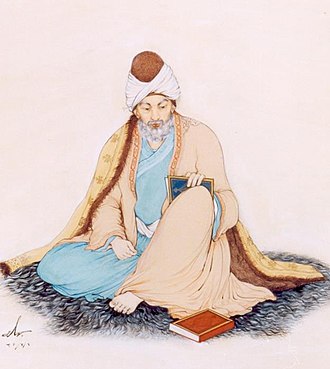 Rumi
Rumi"Yusufislam.org.uk Official site"
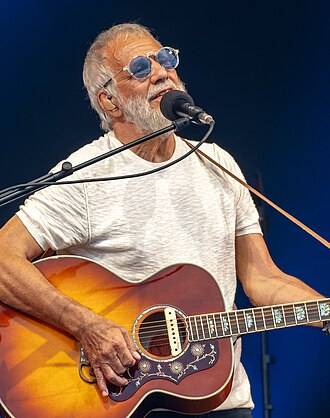 Cat Stevens
"Why should a falcon not fly from the quarry towards the King When it hears by drum and drum-stick the notice of Return? Why should not every Sufi begin to dance like a mote, In the sun of eternity that it may deliver him from decay."
Rumi"Kabir belongs to that small group of supreme mystics amongst whom St. Augustine, Ruysbroeck, and the Sufi poet Jalaluddin Rumi are perhaps the chief who have achieved that which we might call the synthetic vision of God. These have resolved the perpetual opposition between the personal and impersonal, the transcendent and immanent, static and dynamic aspects of the Divine Nature; between the Absolute of philosophy and the "sure true Friend" of devotional religion. They have done this, not by taking these apparently incompatible concepts one after the other; but by ascending to a height of spiritual intuition at which they are, as Ruysbroeck said, "melted and merged in the Unity," and perceived as the completing opposites of a perfect Whole."
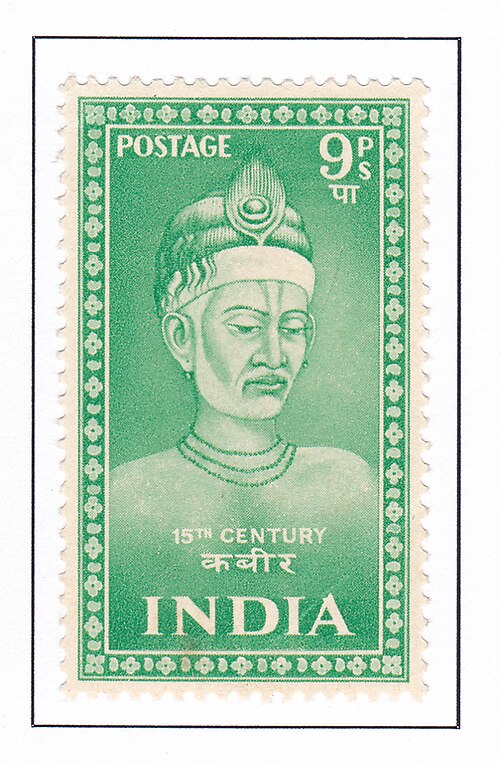 Kabir
Kabir"You must have heard about the beautiful Sufi legend of Majnu and Laila. It is not an ordinary love story. The word majnu means mad, mad for God. And laila is the symbol of God. Sufis think of God as the beloved; laila means the beloved. Everybody is a Majnu, and God is the beloved. And one has to open one’s heart, the eye of the heart."