Quote
"There is in the true man of science a desire stronger than the wish to have his beliefs upheld; namely, the desire to have them true."
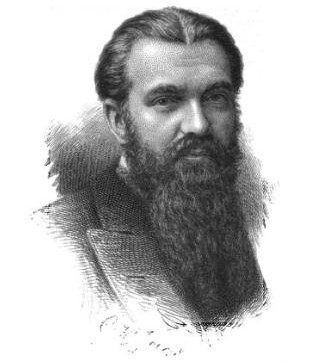 William Kingdon Clifford
"Force cannot be explained without stating a law of nature concerning momentum, viz.:— Suppose a body with a certain momentum to be the only body in the universe; it will go on with the same momentum. The case of bodies in contact is no exception to this law, but only a particular case. Here the change of motion is called pressure. The case of bodies not in contact is illustrated by the motion of the earth about the sun [under the force of gravitation, as we call it]. In all cases change of motion is connected by invariable laws with the position of surrounding bodies. Force, then, has a definite direction [at every instant] at any point in space, and depends on the position of surrounding bodies, and may be described as the change of momentum of a body considered as depending upon its position relative to other things. It embodies the quality of direction as well as magnitude. In other words, it is a quantity having direction."
William Kingdon Clifford was a British mathematician and philosopher. Building on the work of Hermann Grassmann, he introduced what is now termed geometric algebra. This is a special case of what later became known as the Clifford algebra, which was named in his honour. The operations of geometric algebra have the effect of mirroring, rotating, translating, and mapping the geometric objects that a
"There is in the true man of science a desire stronger than the wish to have his beliefs upheld; namely, the desire to have them true."
William Kingdon Clifford"The name philosopher, which meant originally lover of wisdom, has come in some strange way to mean a man who thinks it is his business to explain everything in a certain number of large books. It will be found, I think, that in proportion to his colossal ignorance is the perfection and symmetry of the system which he sets up; because it is so much easier to put an empty room tidy than a full one."
William Kingdon Clifford"I am endeavouring in a general way to explain the laws of double refraction on this hypothesis, but have not yet arrived at any results sufficiently decisive to be communicated."
William Kingdon Clifford"No mathematician can give any meaning to language about matter, force, inertia, used in text-books of mechanics."
William Kingdon Clifford"Remember, then, that [scientific thought] is the guide of action; that the truth which it arrives at is not that which we can ideally contemplate without error, but that which we may act upon without fear; and you cannot fail to see that scientific thought is not an accompaniment or condition of human progress, but human progress itself. And for this reason the question what its characters are... is the question of all questions for the human race."
William Kingdon Clifford"We ought not to teach to little children, as a known fact, that which is not a known fact."
William Kingdon Clifford