Quote
"Thus Nero went up and down Greece and challenged the fiddlers at their trade. Æropus, a Macedonian king, made lanterns; Harcatius, the king of Parthia, was a mole-catcher; and Biantes, the Lydian, filed needles."
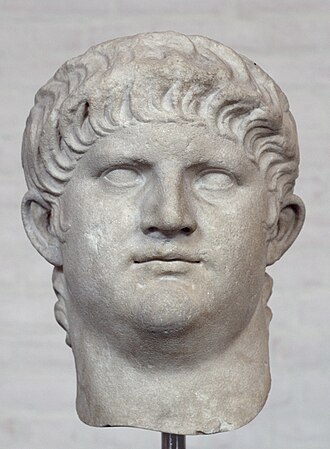 Nero
Nero"God, save us from ourselves! We carry within us the elements of hell if we but choose to make them such. Ahaz, Judas, Nero, Borgia, Herod, all were once prattling infants in happy mothers arms."
Nero Claudius Caesar Augustus Germanicus was a Roman emperor and the final emperor of the Julio-Claudian dynasty, reigning from AD 54 until his suicide in AD 68.
"Thus Nero went up and down Greece and challenged the fiddlers at their trade. Æropus, a Macedonian king, made lanterns; Harcatius, the king of Parthia, was a mole-catcher; and Biantes, the Lydian, filed needles."
Nero"Nero wasn’t worried at all when he heard the utterance of the Delphic Oracle: “Beware the age of seventy-three.” Plenty of time to enjoy himself still. He’s thirty. The deadline the god has given him is quite enough to cope with future dangers. … And in Spain Galba secretly musters and drills his army — Galba, the old man in his seventy-third year."
Nero"The arts of the magician are said to have been called into action by Nero upon occasion of the assassination of his mother, Agrippina. He was visited with occasional fits of the deepest remorse in the recollection of his enormity. Not with-standing all the ostentatious applauses and congratulations which he obtained from the senate, the army and the people, he complained that he was perpetually haunted with the ghost of his mother, and pursued by the Furies with flaming torches and whips. He therefore cased himself to be attended by magicians, who employed their arts to conjure up the shade of Agrippina and to endeavour to obtain her forgiveness for the crime perpetrated by her son. We are not informed of the success of their evocations."
Nero"The emperor who ‘fiddled while Rome burned’, Nero was the last of the Julio-Claudian dynasty that took Rome from Republic to one-man rule. Raised amidst violence and tyranny, he ruled with ludicrous vanity, demented whimsy and inept despotism. Few mourned his abdication and death amidst the chaos that he himself had created."
Nero"Nero saw himself as an artist; his enemies thought of him as a tyrant and a buffoon. The truth is, he was all three. He certainly wasnt very good at running an empire, but then, what did Rome expect? If you put a messed-up sixteen-year-old in charge of half the known world, youre asking for trouble. Rome learned the hard way. From now on, it abandoned the Julio-Claudian line of emperors in favour of skilled administrators. But Nero did leave his mark on history. Whatever else he wasnt, he was a showman. He did everything in a big way, from building his house to killing his mother. He thought of himself as an actor, but no part he ever played on the stage could match the drama, the spectacle and the sheer theatricality of his own life."
Nero"The people love Nero. He inspires in them both affection and respect. There is a reason for this which Tacitus omits. One can discern the reason for this popular feeling: Nero oppressed the great and never burdened the ordinary people. But Tacitus says nothing of this. He speaks of crimes. He speaks of them with passion. We, as a result, feel he is biased; he no longer inspires the same confidence. One is led to believe that he exaggerates; he explains nothing and appears satisfied with vignettes."
Nero