Quote
"The way to combat noxious ideas is with other ideas. The way to combat falsehoods is with truth."
W
William O. Douglas"He was, however, speaking to a representative of government, the police. And it is to government that one goes for a redress of grievances, to use an almost forgotten phrase of the First Amendment. But it is said that the purpose was to cause inconvenience and annoyance. Since when have we Americans been expected to bow submissively to authority and speak with awe and reverence to those who represent us? The constitutional theory is that we the people are the sovereigns, the state and federal officials only our agents. We who have the final word can speak softly or angrily. We can seek to challenge and annoy, as we need not stay docile and quiet."
William Orville Douglas was an American jurist who served as an associate justice of the Supreme Court of the United States from 1939 to 1975. Douglas was known for his strong progressive and civil libertarian views and is often cited as the most liberal justice in the U.S. Supreme Court’s history. Nominated by President Franklin D. Roosevelt in 1939, Douglas was confirmed at the age of 40, becomi
"The way to combat noxious ideas is with other ideas. The way to combat falsehoods is with truth."
"The Constitution is not neutral. It was designed to take the government off the backs of people."
"The vitality of civil and political institutions in our society depends on free discussion. As Chief Justice Hughes wrote in De Jonge v. Oregon, 299 U.S. 353, 365, 260, it is only through free debate and free exchange of ideas that government remains responsive to the will of the people and peaceful change is effected. The right to speak freely and to promote diversity of ideas and programs is therefore one of the chief distinctions that sets us apart from totalitarian regimes. Accordingly a function of free speech under our system of government is to invite dispute. It may indeed best serve its high purpose when it induces a condition of unrest, creates dissatisfaction with conditions as they are, or even stirs people to anger. Speech is often provocative and challenging. It may strike at prejudices and preconceptions and have profound unsettling effects as it presses for acceptance of an idea. That is why freedom of speech, though not absolute, Chaplinsky v. New Hampshire, supra, 315 U.S. at pages 571-572, 62 S.Ct. at page 769, is nevertheless protected against censorship or punishment, unless shown likely to produce a clear and present danger of a serious substantive evil that rises far above public inconvenience, annoyance, or unrest. See Bridges v. California, 314 U.S. 252, 262, 193, 159 A.L.R. 1346; Craig v. Harney, 331 U.S. 367, 373, 1253. There is no room under our Constitution for a more restrictive view. For the alternative would lead to standardization of ideas either by legislatures, courts, or dominant political or community groups.Terminiello, 337 U.S. at 4-5."
"When a legislature undertakes to proscribe the exercise of a citizens constitutional right to free speech, it acts lawlessly; and the citizen can take matters in his own hands and proceed on the basis that such a law is no law at all."
"It is our attitude toward free thought and free expression that will determine our fate. There must be no limit on the range of temperate discussion, no limits on thought. No subject must be taboo. No censor must preside at our assemblies. We need all the ingenuity we possess to avert the holocaust."
"The right to revolt has sources deep in our history."
"In the life of the mass-order, the culture of the generality tends to conform to the demands of the average human being. Spirituality decays through being diffused among the masses when knowledge is impoverished in every possible way by rationalisation until it becomes accessible to the crude understanding of all."
"I say this to you because we Spaniards are a forgetful people, because we are used to living for the moment, because we do not look back, because we do not know how to see the chain of heroes, because we do not contemplate the sum of sacrifices."
 Francisco Franco
"Sharon Tate was my best friend. Once, we were roommates. She introduced me to my husband. She was the godmother to my baby daughter who is named for her. In the six years time that I knew her, she never said an unkind word about anyone."
"Long time to see. (VS: Tapion)"
"Most mathematicians prove what they can, von Neumann proves what he wants." Once in a discussion about the rapid growth of mathematics in modern times, von Neumann was heard to remark that whereas thirty years ago a mathematician could grasp all of mathematics, that is impossible today. Someone asked him: "What percentage of all mathematics might a person aspire to understand today?" Von Neumann went into one of his five-second thinking trances, and said: "About 28 percent."
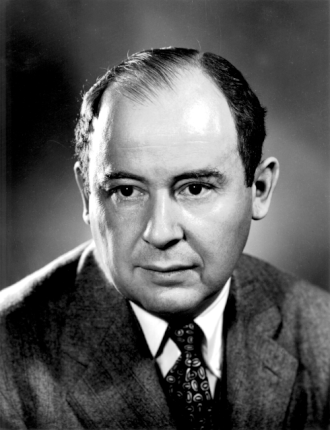 John von Neumann
"Children must be free to think in all directions irrespective of the peculiar ideas of parents who often seal their childrens minds with preconceived prejudices and false concepts of past generations. Unless we are very careful, very careful indeed, and very conscientious, there is still great danger that our children may turn out to be the same kind of people we are."