SHAWORDS

His astronomical tutor, Maestlin, encouraged him to devote himself to — Kepler

HomeKeplerQuote
"His astronomical tutor, Maestlin, encouraged him to devote himself to his newly adopted science, and the first result of this advice appeared before very long in Kepler’s “Mysterium Cosmographicum”. The bent of his mind was towards philosophical speculation, to which he had been attracted in his youthful studies of Scaliger’s “Exoteric Exercises” (Exotericarum exercitationum). He says he devoted much time “to the examination of the nature of heaven, of souls, of genii, of the elements, of the essence of fire, of the cause of fountains, the ebb and flow of the tides, the shape of the continents and inland seas, and things of this sort.”"
Kepler
Kepler
Kepler
author65 quotes

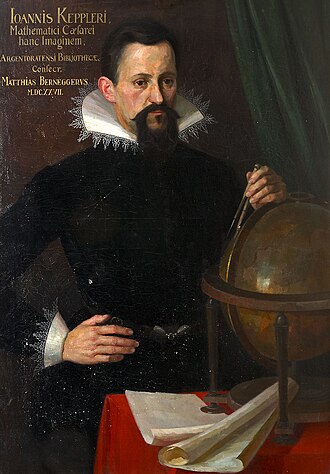
Johannes Kepler was a German polymath who was an astronomer, mathematician, astrologer, natural philosopher and music theorist. He is a key figure in the 17th-century Scientific Revolution, best known for his laws of planetary motion, and his books Astronomia nova, Harmonice Mundi, and Epitome Astronomiae Copernicanae. The variety and impact of his work made Kepler one of the founders and fathers

More by Kepler

View all →
Quote
"His [ Copernicus ] considerations were almost entirely mathematical, his only invasion into physics being in defense of the “moving earth” against the stock objection that if the earth moved, loose objects would fly off, and towers fall. He did not break sufficiently away from the old tradition of uniform circular motion. ...he would not sacrifice the old fetish, and so, the orbit of the earth being clearly not circular with respect to the sun, he made all his planetary planes pass through the center of the earth’s orbit, instead of through the sun, thus handicapping himself in the same way though not in the same degree as Ptolemy. His thirty-four circles or epicycles comprised four for the earth, three for the moon, seven for Mercury (on account of his highly eccentric orbit) and five each for the other planets."
KeplerKepler
Quote
"Eudoxus of Cnidus, endeavouring to account for the fact that the planets, during every apparent revolution round the earth, come to rest twice, and in the shorter interval between these “stationary points,” move in the opposite direction, found that he could represent the phenomena fairly well by a system of concentric spheres, each rotating with its own velocity, and carrying its own particular planet round its own equator, the outermost sphere carrying the fixed stars. ...the total number required by Aristotle reaching fifty-five."
KeplerKepler