SHAWORDS

How far we are to consider the interests of posterity when they seem t — Utilitarianism

"How far we are to consider the interests of posterity when they seem to conflict with those of now-existing human beings? The answer to this, though, seems clear: the time at which a man exists can’t affect the value of his happiness from a universal point of view; so the interests of posterity must concern a utilitarian as much as those of his contemporaries—except in that the effect of his actions on the lives and even the existence of posterity must be more uncertain."
U
Utilitarianism
Utilitarianism
author37 quotes

Utilitarianism is a family of theories in normative ethics that prescribe actions that maximize happiness and well-being for the affected individuals. In other words, utilitarian ideas encourage actions that lead to the greatest good for the greatest number. Although different varieties of utilitarianism admit different characterizations, the basic idea that underpins them all is, in some sense, t

More by Utilitarianism

View all →
Quote
"The utilitarian behaves sensibly in all that is required for preservation but never takes account of the fact that he must die. He does everything reasonable to put off the day of his death—providing for defense, peace, order, health and wealth —but actively suppresses the fact that the day must come. His whole life is absorbed in avoiding death, which is inevitable, and therefore he might be thought to be the most irrational of men, if rationality has anything to do with understanding ends or comprehending the human situation as such."
U
Utilitarianism
Quote
"the happiness which forms the utilitarian standard of what is right in conduct, is not the agents own happiness, but that of all concerned. As between his own happiness and that of others, utilitarianism requires him to be as strictly impartial as a disinterested and benevolent spectator. In the golden rule of Jesus of Nazareth, we read the complete spirit of the ethics of utility. To do as one would be done by, and to love ones neighbour as oneself, constitute the ideal perfection of utilitarian morality."
U
Utilitarianism
Quote
"In their time, Benthams ideas promoted progress, reform, wider democracy, and the amelioration of undesirable social conditions. Bentham lived... when common people, the "labouring poor," had little voice and no vote... Their toil and sacrifices enhanced the power of the nation, the glory of its rulers, the wealth of industrialists and merchants, and the indolent ease of the aristocrats. Yet here was a philosopher who said that people are people regardless of their social position. ...[L]egislators ought actively to augment the total happiness of the community. Instead of the people serving the state, the state should serve the people. ...[H]is slogan for government was "Be quiet." But he did not worship laissez-faire as a principle to be accepted blindly. ...[T]he state should monopolize the issue of paper money, thereby saving interest on its borrowing. It should... operate life and annuity insurance, and tax inheritance, monopolies, [etc.] ...Benthams idea of diminishing marginal utility of money suggested an argument for the redistribution of income. ...[M]ore happiness will be gained by the poor... than will be lost by the wealthy... Benthams devotion to the greatest good for the greatest number led him to... advocate for.. democratic reforms. He supported universal (male) suffrage, equal electoral districts, annual parliaments, and the secret ballot. He opposed the monarchy and the , arguing that only in a democracy do the interest of the gonernors and the governed become identical. ...Bentham urged a system of national education, even for pauper children. Frugality Banks... should... stimulate saving by the poor. should provide jobs for unemployed workers during slack times. ...He designed ...a model prison that would reform criminals rather than punish them. No wonder Bentham and his circle of intellects (including James Mill, John Stuart Mill, and Ricardo) were called "philosophic radicals."
U
Utilitarianism

More on Time

View all →
Quote
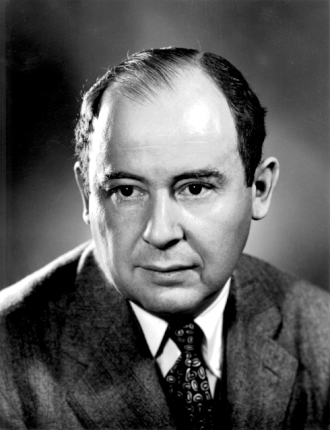
"Most mathematicians prove what they can, von Neumann proves what he wants." Once in a discussion about the rapid growth of mathematics in modern times, von Neumann was heard to remark that whereas thirty years ago a mathematician could grasp all of mathematics, that is impossible today. Someone asked him: "What percentage of all mathematics might a person aspire to understand today?" Von Neumann went into one of his five-second thinking trances, and said: "About 28 percent."
John von NeumannJohn von Neumann