SHAWORDS

I do not care if they insult me or Aaron, but I insist that the insult — Torah study

HomeTorah studyQuote
"I do not care if they insult me or Aaron, but I insist that the insult of the Torah be avenged. If these men die the common death of all men, I shall myself become a disbeliever and declare the Torah was not given by God."
Torah study
Torah study
Torah study
author

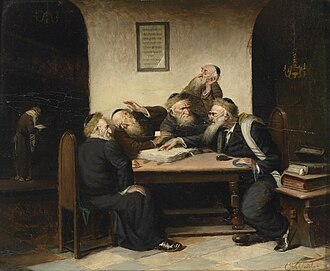
Torah study is the study of the Torah, Hebrew Bible, Talmud, responsa, rabbinic literature, and similar works, all of which are Judaism's religious texts. According to Rabbinic Judaism, the study is done for the purpose of the mitzvah ("commandment") of Torah study itself.

More by Torah study

View all →
Quote
"The origins of Rabbinic literature go at least as far back as the second century BCE. Some of the books Misrash of Rabbinic interpretations of the Bible, or misrash although based on materials dating earlier than the sixth century CE, were not committed to writing and edited together until the eleventh or twelfth century CE. The scholars of the Bible from the time of Ezra on are first called “scribes,” because their first job was to make copies of the Torah. They are then called “sages” (‘’hakhamim’’), because in copying the Torah they came to know it and to interpret and apply it. The title “rabbi”, meaning master and teacher of the tradition, appears in the first century CE. The title persists to this day, but it is the classical Rabbis of the second century BCE through the sixth century CE to whose words we refer when we speak of Rabbinic literature."
Torah studyTorah study
Quote
"The entire oral law in the wider sense, namely, the entire material of the Mishnah, the Tosefta, and the halakic midrashim, was preserved only orally, and was not reduced to writing until the beginning of the third century C.E., because there was a prejudice against recording halakot. The origin of this objection is unknown. There has never been any formal interdiction against recording halakot, nor are there any references to any date of such a prohibition or to any person who issued one. Even the two Talmudic passages which allude to the custom of not recording halakot do not mention a formal interdiction. One of these passages, the comment of Judah b. Naḥmani, "What has been said orally thou mayest not say in writing, and vice versa" (Giṭ. 60b and parallel passages), is merely a haggadic explanation of the prevailing custom. If this interpretation had been taken literally, the Prophets would not have been allowed to commit their prophecies to writing (comp. Weiss, "Dor," i. 92 et seq.). The second passage, which is by R. Johanan and reads as follows: "He who records halakot is like him who burns the Torah; and whosoever studies these written collections has no reward" (Tem. 14b), is merely a reproof directed against those who make such compilations for public use. As the Mishnah had been committed to writing by the time of R. Johanan (199-279), there could be no question of a prohibition against recording halakot."
Torah studyTorah study