SHAWORDS

I find it difficult to say whether the leaderships second echelon coul — East Germany

HomeEast GermanyQuote
"I find it difficult to say whether the leaderships second echelon could have preserved the German Democratic Republic. Helmut Kohl later told me he had never believed that Egon Krenz was capable of getting the situation under control. I do not know - we are all wiser after the event, as the saying goes. For my part, I must admit I briefly had a faint hope that the new leaders would be able to change the course of events by establishing a new type of relations between the two German states - based on radical domestic reforms in East Germany."
East Germany
East Germany
East Germany
author8 quotes

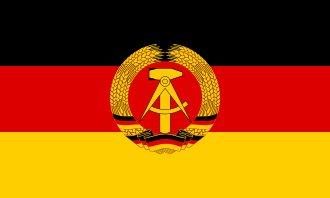
East Germany, officially the German Democratic Republic (GDR), was a country in Central Europe from its formation on 7 October 1949 until its reunification with West Germany on 3 October 1990. Until 1989, it was generally viewed as a communist state and described itself as a socialist workers' and peasants' state.

More by East Germany

View all →
Quote
"If the Soviet zone, after the initial chaos, for a while seemed to work better than the west, this was due not so much to Stalin as to Red Army administrators and the German Communists who had come back with them. They were more than ready to take over the centralized planning systems that had existed in Nazi Germany and to rely on them in order to get basic infrastructure and production going wherever possible. After a while former Nazi officials at the lower levels—those the Soviets decided not to put on trial—also found it remarkably easy to collaborate; the Communist ideas of planning were not, after all, that different from those of their former masters. Publicly, however, the new east German authorities held high the banner of anti-Fascism. They were the “good Germans”; the bad Germans, plenty of them, were all collaborating in the western occupation zones, or so German Communist propaganda claimed. Many Left-wing Germans fell for the disinformation, especially intellectuals and artists, some of whom moved east, including top names in German literature like Stefan Heym and Bertolt Brecht, who both moved there from wartime exile in the United States. In the spring of 1946 the Soviets and the German Communists forced the Social Democrats in the east into a Socialist Unity Party (SED), in which the Communists under Wilhelm Pieck and Walter Ulbricht had full control. Again, some non- Communist Left-wingers joined enthusiastically, believing that they thereby made up for the failure of the German Left to cooperate against Hitler in the 1930s. Most Social Democrats were made of sterner stuff, however, and fought to keep their party separate, even if it meant relocating to the western occupation zones. Still, the SED scored enough successes for Stalin to be convinced that there would be a future for Soviet political influence in a united Germany."
East GermanyEast Germany
Quote
"It seems to me that certain definite patterns are emerging from the situation in East Germany and the Eastern European satellite countries--patterns which will unquestionably have a profound effect upon the future, including the proposed meeting of the Foreign Ministers of the Four Powers. I think, therefore, that it will be useful for me to share my thoughts with you in some detail at this time. Great historical developments, such as the recent Berlin and East German anti-Communist demonstrations, rarely have single roots. Nevertheless, I am quite certain that future historians, in their analysis of the causes which will have brought about the disintegration of the Communist Empire, will single out those brave East Germans who dared to rise against the cannons of tyranny with nothing but their bare hands and their stout hearts, as a root cause. I think also that those same historians will record your own extraordinary steadfastness in the cause of European peace and freedom over many, many years."
East GermanyEast Germany
Quote
"A persuasive way of understanding the collapse of Communism in Europe and the Soviet Union is to think of nineteenth- or twentieth-century slum clearance. For in many respects the Soviet Empire was a slum of continental proportions. Beyond the grotesque architectural assertions of an alien ideology, public housing – almost all housing – consisted of anomic and primitive concrete barracks where the smells of cabbage, damp and low-grade tobacco combined. Rivers and lakes were polluted by chemicals, with the Pleisse river in East Germany alternately turning first red then yellow."
East GermanyEast Germany
Quote
"The creation of two German states, an event unforeseen at Tehran, Yalta, or even at Potsdam, was a signal Cold War phenomenon. Foreshadowed by the dual occupation of Korea, Germany’s partition in 1949 combined both real and symbolic elements as a means of stabilizing Central Europe as well as a punishment for the Nazis’ crimes. Four-power occupation had worked in Austria—thanks to the smaller strategic stakes, a moderate socialist government, and the Allies’ Tehran decision to treat this country gently as “Hitler’s first victim”—and the country remained intact. In the more populous, resource-rich Germany, which lacked a central government, the occupiers were able to dominate the revival of local politics. East Germany became the first “workers’ and peasants’ state on German soil,” and West Germany a liberal, robustly capitalist state. Both regimes represented not only a renunciation of the Nazi past but also the revitalization of two opposing political traditions—Marxism and liberalism—each claiming redemptive power over Germany and Europe’s future and each mirroring the Cold War itself."
East GermanyEast Germany