Quote
"The death rate is the same for us as for anybody...one person, one death, sooner or later."
R
Robert A. Heinlein"I found Robert A. Heinlein in back issues of Astounding, and also in The Saturday Evening Post, and I read everything of his I could find. I was completely hooked on his "juveniles": Space Cadet. Red Planet. Starman Jones. Between Planets. Farmer in the Sky. Wonderful stories, and the only thing "juvenile" about them was that he took the trouble to explain what was happening. Robert once told me that young people want to know how things work, and you can tell them more in a "juvenile" than you can in an adult novel. In any event I devoured everything of his I could find, through high school, the army, college, and I couldn’t have cared less that many were "juveniles". They were wonderful. I met Robert Heinlein years later, and through some kind of rare magic we became instant friends. We corresponded for a decade. In those days I was an engineering psychologist, operations research specialist, and systems engineer in aerospace. Most of my work was military aerospace, but I did get to work on Mercury, Gemini, and Apollo. We were helping to make the dream come true! I went from there to a professorship, and then into political management and city government. Robert visited me when I was working for Mayor Sam Yorty. "You probably don’t know this," he said, "but my political career ended when Yorty beat me for the Democratic nomination to the State Assembly." When I finally decided to get out of politics, academia, and the aerospace industry and try my hand at writing, Mr. Heinlein was enormously helpful. Years later, when I was an established writer, I asked him how I could pay him back. "You can’t," he said. "You don’t pay back, you pay forward." I never forgot that, just as I never forgot the wonderful things his ‘juvenile’ stories did for me."
Robert Anson Heinlein was an American science fiction author, engineer, and naval officer. Sometimes called the "dean of science fiction writers", he was among the first to emphasize scientific accuracy in his fiction and was thus a pioneer of the subgenre of hard science fiction. His published works, both fiction and non-fiction, express admiration for competence and emphasize the value of critic
"The death rate is the same for us as for anybody...one person, one death, sooner or later."
"“So far as I have listened, before a revolution can take place, the population must lose faith in both the police and the courts.” “Elementary. Go on.” “Well…high taxation is important and so is inflation of the currency and the ratio of the productive to those on the public payroll. But that’s old hat; everybody knows that a country is on the skids when its income and outgo get out of balance and stay that way—even though there are always endless attempts to wish it away by legislation.”"
"Now look carefully at what I said. I said that I know that these things are asserted. I did not say that they are true."
"Boats and ships are female because they are beautiful, lovable, expensive—and unpredictable."
"I think the major problem in growing up is to become sophisticated without becoming cynical."
"“If there was anything, anything more at all, after this crazy mix-up we call living, I could feel that there might be some point to the whole frantic business, even if I did not know and could not know the full answer while I was alive.” “And suppose there was not? Suppose that when a man’s body disintegrates, he himself disappears absolutely. I’m bound to say I find it a probable hypothesis.” “Well— It wouldn’t be cheerful knowledge, but it would be better than not knowing. You could plan your life rationally, at least. A man might even be able to get a certain amount of satisfaction in planning things better for the future, after he’s gone. A vicarious pleasure in the anticipation.”"
"In the life of the mass-order, the culture of the generality tends to conform to the demands of the average human being. Spirituality decays through being diffused among the masses when knowledge is impoverished in every possible way by rationalisation until it becomes accessible to the crude understanding of all."
"I say this to you because we Spaniards are a forgetful people, because we are used to living for the moment, because we do not look back, because we do not know how to see the chain of heroes, because we do not contemplate the sum of sacrifices."
 Francisco Franco
"Sharon Tate was my best friend. Once, we were roommates. She introduced me to my husband. She was the godmother to my baby daughter who is named for her. In the six years time that I knew her, she never said an unkind word about anyone."
"Long time to see. (VS: Tapion)"
"Most mathematicians prove what they can, von Neumann proves what he wants." Once in a discussion about the rapid growth of mathematics in modern times, von Neumann was heard to remark that whereas thirty years ago a mathematician could grasp all of mathematics, that is impossible today. Someone asked him: "What percentage of all mathematics might a person aspire to understand today?" Von Neumann went into one of his five-second thinking trances, and said: "About 28 percent."
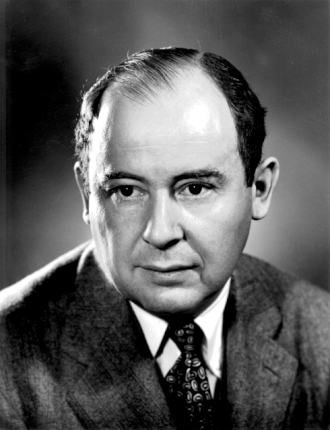 John von Neumann
"Children must be free to think in all directions irrespective of the peculiar ideas of parents who often seal their childrens minds with preconceived prejudices and false concepts of past generations. Unless we are very careful, very careful indeed, and very conscientious, there is still great danger that our children may turn out to be the same kind of people we are."