Quote
"I once asked my mom, "Why were you a socialist and not a communist?" And she said, "Better doughnuts."
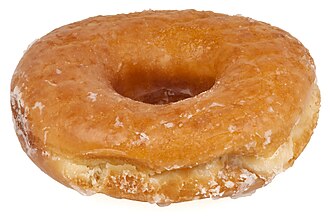 Doughnut
"I hold here a contract between myself and one pledging me his soul for a doughnut — which I delivered ..."
A doughnut or donut is a type of pastry made from leavened fried dough. It is popular in many countries and is prepared in various forms as a sweet snack that can be homemade or purchased in bakeries, supermarkets, food stalls, and franchised specialty vendors.
"I once asked my mom, "Why were you a socialist and not a communist?" And she said, "Better doughnuts."
Doughnut"Doughnuts might have been designed for dunking. A doughnut, like bread is held together by an elastic net of the protein . The gluten might stretch, and eventually even break, when the doughnut is dunked in hot coffee, but it doesnt swell or dissolve as the liquid is drawn into the network of holes and channels that the gluten supports. This means that the doughnut dunker can take his or her time, pausing only to let the excess liquid drain back into the cup before easing the doughnut to the waiting mouth."
Doughnut"Doughnuts loom as one more horrid substance we shovel into our collective mouths, symbols of Americans ever-increasing laziness and obesity ... For many of us, doughnuts are a very special treat that has a very special status and were not going to give it up. Or its going to be one of the last treats that were going to give up."
Doughnut"The first known appearance of donut in print was in a childrens book, Pecks Bad Boy and His Pa, published in 1900. He would just drink a cup of coffee and eat a donut. The cookbooks of the time used doughnut, and so it apparently remained until the 1920s, when Adolph Levitt, then owner of the New York-based Display Doughnut Machine Corporation, sought to promote his automated doughnut machines to foreign buyers, and donut seemed a convenient shorthand. Perhaps his inspiration came from abbreviated spellings on street signs, for example Dnuts for sale, or from his many Jewish customers; the Yiddish word donat applies to an unfilled doughnut, as of course were those made by his machines. In America the interchangeability of the two spellings was established by the end of the 1930s, and the use of donut has slowly increased in use there."
Doughnut"Shape with a doughnut cutter, fry in deep fat, take up on a skewer, and drain on brown paper. Add trimmings to one-half remaining mixture, roll, shape, and fry as before; repeat. Doughnuts should come quickly to top of fat, brown on one side, then be turned to brown on the other; avoid turning more than once. The fat must be kept at a uniform temperature. If too cold, doughnuts will absorb fat; if too hot, doughnuts will brown before sufficiently risen."
Doughnut