SHAWORDS

I often say that when you can measure what you are speaking about, and — William Thomson

"I often say that when you can measure what you are speaking about, and express it in numbers, you know something about it; but when you cannot measure it, when you cannot express it in numbers, your knowledge is of a meagre and unsatisfactory kind; it may be the beginning of knowledge, but you have scarcely, in your thoughts, advanced to the stage of science, whatever the matter may be."
W
William Thomson
William Thomson
author21 quotes

More by William Thomson

View all →
Quote
"He was one of the few scientists to be knighted, and the only one in the nineteenth century to be raised to the peerage. These honors, however, were not in recognition of his scientific work but his genius as an engineer in solving the major technical problems of laying the first Atlantic cable and his entrepreneurial success as an instrument designer and manufacturer for the new electrical industries and the Navy. With his success with the Atlantic cable Kelvin became a symbol of science to the general public."
W
William Thomson
Quote
"Thomson was a mathematical prodigy. At age 16, he mastered ’s and wrote and published a defense of it. Fourier’s theory allowed one to determine the distribution of heat in a body on the sole assumption that heat flow is proportional to temperature gradient. The approach was macroscopic, geometrical, and nonhypothetical, and Thomson took to it easily. During his undergraduate years at , he traveled to Paris and met the mathematical savants—in particular, mathematician Joseph Liouville and experimental physicist , who both considered Michael Faraday’s curved lines of force outré. At Liouville’s urging, Thomson produced for the a demonstration that the lines of force, whether electric or magnetic, followed from inverse square laws. The relevant mathematics was a near cousin to that for heat flow, but the insight was new and would be seminal in the thinking that led James Clerk Maxwell to electromagnetic field theory."
W
William Thomson
Quote
"It is conceivable that animal life might have the attribute of using the heat of surrounding matter, at its natural temperature, as a source of energy for mechanical effect . . . .The influence of animal or vegetable life on matter is infinitely beyond the range of any scientific enquiry hitherto entered on. Its power of directing the motions of moving particles, in the demonstrated daily miracle of our human free-will, and in the growth of generation after generation of plants from a single seed, are infinitely different from any possible result of the fortuitous concurrence of atoms."
W
William Thomson
Quote
"1. There is at present in the material world a universal tendency to the dissipation of mechanical energy. 2. Any restoration of mechanical energy, without more than an equivalent of dissipation, is impossible in inanimate material processes, and is probably never effected by means of organized matter, either endowed with vegetable life or subjected to the will of an animated creature. 3. Within a finite period of time past, the earth must have been, and within a finite period of time to come the earth must again be, unfit for the habitation of man as at present constituted, unless operations have been, or are to be performed, which are impossible under the laws to which the known operations going on at present in the material world are subject."
W
William Thomson

More on Time

View all →
Quote
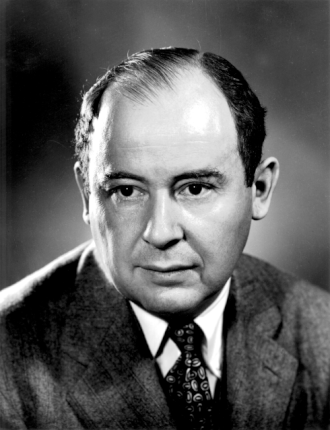
"Most mathematicians prove what they can, von Neumann proves what he wants." Once in a discussion about the rapid growth of mathematics in modern times, von Neumann was heard to remark that whereas thirty years ago a mathematician could grasp all of mathematics, that is impossible today. Someone asked him: "What percentage of all mathematics might a person aspire to understand today?" Von Neumann went into one of his five-second thinking trances, and said: "About 28 percent."
John von NeumannJohn von Neumann