SHAWORDS

If a person is sometimes in the right, sometimes in the wrong, to some — Either/Or

HomeEither/OrQuote
"If a person is sometimes in the right, sometimes in the wrong, to some degree in the right, to some degree in the wrong, who, then, is the one who makes that decision except the person himself, but in the decision may he not again be to some degree to the right and to some degree in the wrong? Or is he a different person when he judges his act then when he acts? Is doubt to rule, then, continually to discover new difficulties, and is care to accompany the anguished soul and drum past experiences into it? Or would we prefer continually to be in the right in the way irrational creatures are? Then we have only the choice between being nothing in relation to God or having to begin all over again every moment in eternal torment, yet without being able to begin, for if we are able to decide definitely with regard to the previous moment, and so further and further back. Doubt is again set in motion, care again aroused; let us try to calm it by deliberating on: The Upbuilding That Lies In The Thought That In Relation To God We Are Always In The Wrong."
E
Either/Or
Either/Or
author52 quotes

More by Either/Or

View all →
Quote
"When I was young, I forgot how to laugh in the cave of Trophonius; when I was older, I opened my eyes and beheld reality, at which I began to laugh, and since then, I have not stopped laughing. I saw that the meaning of life was to secure a livelihood, and that its goal was to attain a high position; that love’s rich dream was marriage with an heiress; that friendship’s blessing was help in financial difficulties; that wisdom was what the majority assumed it to be; that enthusiasm consisted in making a speech; that it was courage to risk the loss of ten dollars; that kindness consisted in saying, “You are welcome,” at the dinner table; that piety consisted in going to communion once a year. This I saw, and I laughed."
E
Either/Or
Quote
"People flock about the poet and say to him: do sing again; Which means, would that new sufferings tormented your soul, and: would that your lips stayed fashioned as before, for your cries would only terrify us, but your music is delightful. And the critics join them, saying: well done, thus must it be according to the laws of aesthetics. Why, to be sure, a critic resembles a poet as one pea another, the only difference being that he has no anguish in his heart and no music on his lips. Behold, therefore would I rather be a swineherd on Amager, and be understood by the swine than a poet, and misunderstood by men."
E
Either/Or

More on Time

View all →
Quote
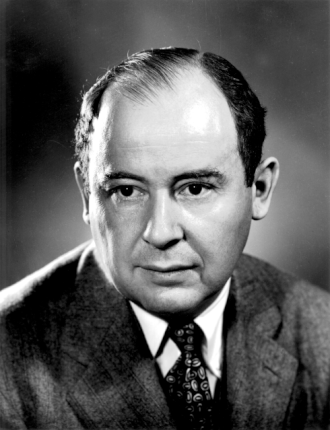
"Most mathematicians prove what they can, von Neumann proves what he wants." Once in a discussion about the rapid growth of mathematics in modern times, von Neumann was heard to remark that whereas thirty years ago a mathematician could grasp all of mathematics, that is impossible today. Someone asked him: "What percentage of all mathematics might a person aspire to understand today?" Von Neumann went into one of his five-second thinking trances, and said: "About 28 percent."
John von NeumannJohn von Neumann