SHAWORDS

If we all worked on the assumption that what is accepted as true is re — Orville Wright

"If we all worked on the assumption that what is accepted as true is really true, there would be little hope of advance."
Orville Wright
Orville Wright
Orville Wright
author10 quotes

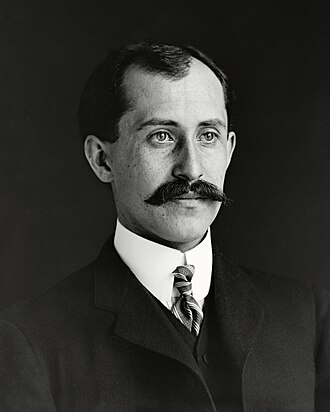
The Wright brothers, Orville Wright and Wilbur Wright, were American aviation pioneers generally credited with inventing, building, and flying the world's first successful airplane. They made the first controlled, sustained flight of an engine-powered, heavier-than-air aircraft with the Wright Flyer on December 17, 1903, four miles (6 km) south of Kitty Hawk, North Carolina, at what is now known a

More by Orville Wright

View all →
Quote
"The course of the flight up and down was exceedingly erratic, partly due to the irregularity of the air, and partly to lack of experience in handling this machine. The control of the front rudder was difficult on account of its being balanced too near the center. This gave it a tendency to turn itself when started; so that it turned too far on one side and then too far on the other. As a result the machine would rise suddenly to about ten feet, and then as suddenly dart for the ground. A sudden dart when a little over a hundred feet from the end of the track, or a little over 120 feet from the point at which it rose into the air, ended the flight. As the velocity of the wind was over 35 feet per second and the speed of the machine against this wind ten feet per second, the speed of the machine relative to the air was over 45 feet per second, and the length of the flight was equivalent to a flight of 540 feet made in calm air. This flight lasted only 12 seconds, but it was nevertheless the first in the history of the world in which a machine carrying a man had raised itself by its own power into the air in full flight, had sailed forward without reduction of speed, and had finally landed at a point as high as that from which it started."
Orville WrightOrville Wright
Quote
"Wilbur, having used his turn in the unsuccessful attempt on the 14th, the right to the first trial now belonged to me. After running the motor a few minutes to heat it up, I released the wire that held the machine to the track, and the machine started forward into the wind. Wilbur ran at the side of the machine, holding the wing to balance it on the track. Unlike the start on the 14th, made in a calm, the machine, facing a 27-mile wind, started very slowly. Wilbur was able to stay with it till it lifted from the track after a forty-foot run. One of the life saving men snapped the camera for us, taking a picture just as the machine had reached the end of the track and had risen to a height of about two feet. The slow forward speed of the machine over the ground is clearly shown in the picture by Wilbur’s attitude. He stayed along beside the machine without any effort."
Orville WrightOrville Wright
Quote
"For two reasons we decided to use two propellers. In the first place we could, by the use of two propellers, secure a reaction against a greater quantity of air, and at the same time use a larger pitch angle than was possible with one propeller; and in the second place by having the propellers turn in opposite directions, the gyroscopic action of one would neutralize that of the other. The method we adopted of driving the propellers in opposite directions by means of chains is now too well known to need description here. We decided to place the motor to one side of the man, so that in case of a plunge headfirst, the motor could not fall upon him. In our gliding experiments we had had a number of experiences in which we had landed upon one wing, but the crushing of the wing had absorbed the shock, so that we were not uneasy about the motor in case of a landing of that kind. To provide against the machine rolling over forward in landing, we designed skids like sled runners, extending out in front of the main surfaces."
Orville WrightOrville Wright
Quote
"Wilbur started the fourth and last flight at just 12 o’clock. The first few hundred feet were up and down as before, but by the time three hundred feet had been covered, the machine was under much better control. The course for the next four or five hundred feet had but little undulation. However, when out about eight hundred feet the machine began pitching again, and, in one of its starts downward, struck the ground. The distance over the ground was measured and found to be 852 feet; the time of the flight 59 seconds. The frame supporting the front rudder was badly broken, but the main part of the machine was not injured at all. We estimated that the machine could be put in condition for flight again in a day or two. While we were standing about discussing this last flight, a sudden strong gust of wind struck the machine and began to turn it over. Everybody made a rush for it. Wilbur, who was at one end, seized it in front, Mr. Daniels and I, who were behind, tried to stop it by holding to the rear uprights. All our efforts were vain. The machine rolled over and over. Daniels, who had retained his grip, was carried along with it, and was thrown about head over heels inside of the machine. Fortunately he was not seriously injured, though badly bruised in falling about against the motor, chain guides, etc. The ribs in the surfaces of the machine were broken, the motor injured and the chain guides badly bent, so that all possibility of further flights with it for that year were at an end."
Orville WrightOrville Wright