Quote
"I want to help women achieve their career goals and navigate obstacles, and provide our alumnae with ongoing education and the opportunity to share their experiences."
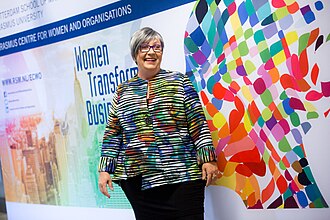 Dianne Bevelander
"I’m always slightly embarrassed thinking back to how I just didn’t see things that are often blindingly obvious to me today. For instance, the way business education often perpetuates gender bias, through texts, cases, business speakers, and even faculty. The turning point came when I undertook research into social networks amongst our MBA students. I wanting to see if there was real collaboration amongst the extremely diverse student population in the RSM classroom. Were the Japanese working with the Spanish? Were the Nigerians socialising with the Dutch? Were the Mexicans exploring innovative ideas with the Chinese?"
Dianne Lynne Bevelander was a South African academic. She was the founder and executive director of the Erasmus Centre for Women and Organisations (ECWO) and Professor of Management Education with a focus on Women in Business at Rotterdam School of Management, Erasmus University (RSM). She was a pioneer of gender equality there, as she established the first all-women leadership elective as part of
"I want to help women achieve their career goals and navigate obstacles, and provide our alumnae with ongoing education and the opportunity to share their experiences."
Dianne Bevelander"In corporate culture there is a language of gender bias that we are unaware of: it’s called “benevolent sexism”.’ An example of this is when a male colleague or supervisor refers to a highly trained, qualified female engineer as “honey” or “meisje”. ‘Everyone acts as if it’s okay. It’s not. Deconstruct it. It’s not being friendly. It’s a power thing."
Dianne Bevelander"I wanted to show people that although I had cancer, was not ill. I was still able to add value and do things in spite of the chemo and the damned tumours it was desperately fighting. This was important to me because a cancer diagnosis often gets one marginalised."
Dianne Bevelander"Many women stay in job or remain in a toxic environment because they are scared. My message to them is do not sell out who they are in exchange for safety. It takes courage to move because it takes you outside your comfort zone, especially the first time you do it. However, you will soon realise that your world does not collapse when you find the courage to change and get off the hamster wheel."
Dianne Bevelander"If you cannot find something positive to say about another woman, say nothing at all."
Dianne Bevelander"The issue is that women have to realise how phenomenal, creative and innovative they are. We don’t believe that we need to “fix” women for success in the corporate world. Rather, we need to get them to appreciate their potential and their power."
Dianne Bevelander