Quote
"The control of large numbers is possible and like unto that of small numbers, if we subdivide them."
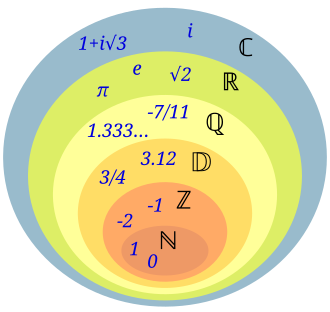 Number
"In a rough way we may summarize the conclusions of the writers to whom reference has chiefly been made, as follows: 1. Let the child learn to count things, thus getting the notion of number. These things are, for the purpose of counting, considered alike, and they may be single objects or groups. 2. Let him acquire the number series, exercising with it beyond the circle of actually counted things. 3. In the learning of symbols it does not seem to be a matter of moment as to whether these are given with the first presentation of number or not. They must, however, be acquired soon. 4. Unconsciously and gradually the child will acquire the idea (never expressed to him in words) of the one-to-one correspondence of number, name, symbol, and thereafter the pure concept of number will play a small part in his arithmetical calculations. 5. The ratio idea of number should be introduced early, and applied in the work with fractions."
A number is a mathematical object used to count, measure, and label. The most basic examples are the natural numbers: 1, 2, 3, 4, 5, and so forth. Individual numbers can be represented in spoken or written language with number words, or with dedicated symbols called numerals; for example, "eleven" is a number word and "11" is the corresponding numeral. As only a limited list of symbols can be memo
"The control of large numbers is possible and like unto that of small numbers, if we subdivide them."
Number"In Greek theoretical mathematics (as distinguished from practical or commercial arithmetic) a fraction that we would write as a/b was not regarded as a number, as a single entity, but as a relationship or a : b between the whole numbers a and b. Thus the ratio a : b was, in modern terms, simply an ordered pair, rather than a rational number."
Number"By the ancients [Greeks], arithmetic was studied through geometry. If a number was regarded as simple, it was a line. If as composite, it was a rectangular figure. To multiply was to construct a rectangle, to divide was to find one of its sides. Traces of this still remain in such terms as square, cube, common measure, but the method itself is obsolete. Hence, it requires an effort to conceive of the square root, not as that which multiplied into itself produces a given number, but as the side of a square, which [square area] either is the number, or is equal to the rectangle which is the number."
Number"Cest de lInde que nous vient lingénieuse méthode dexprimer tous les nombres avec dix caractères, en leur donnant à la fois, une valeur absolue et une valeur de position; idée fine et importante, qui nous paraît maîntenant si simple, que nous en sentons à peine, le mérite. Mais cette simplicité même, et lextrême facilité qui en résulte pour tous les calculs, placent notre système darithmétique au premier rang des inventions utiles; et lon appréciera la difficulté dy parvenir, si lon considère quil a échappé au génie dArchimède et dApollonius, deux des plus grands hommes dont lantiquité shonore."
Number"[Gottlob Frege] had set himself the task of defining the fundamental concept of arithmetic—i.e. number—in terms that succeeded in stripping off all the irrelevant accretions that veil it from the eye of the mind, and so displaying it in its pure form. For his purposes, it was beside the point to ask how mens actual use of number-conceptions had developed historically, or what differences anthropologists had found between the methods of counting and figuring used in different cultures; such factual studies merely chronicled the changing meanings of number-words in our historical gropings towards fully adequate or pure number-conceptions. A rationally based arithmetic, by contrast, must concern itself with the ideal and final system of number-concepts, and this will provide a unique intellectual standard, or template, for judging all mens earlier and cruder proto-arithmetical creations. The analysis of number concepts must therefore be undertaken using the instruments of logic alone. It calls for the construction and interpretation of a rigorous axiomatic system already being worked out for arithmetic by... Peano. Freges Foundations of Arithmetic served as a philosophical example which was soon followed by others. The program... became a model for Bertrand Russells work on philosophical logic, and for half a centurys research on philosophy of science..."
Number"In speaking of arithmetic (algebra, analysis) as a part of logic I mean to imply that I consider the number concept entirely independent of the notions or intuitions of space and time, that I consider it an immediate result from the laws of thought. My answer to the problems propounded in... this paper is... briefly this: numbers are free creations of the human mind; they serve as a means of apprehending more easily and more sharply the difference of things. It is only through the purely logical process of building up the science of numbers and by thus acquiring the continuous number-domain that we are prepared accurately to investigate our notions of space and time by bringing them into relation with this number domain created in our mind."
Number