Quote
"In the same society in which the processes of production and distribution will go on far out at the circumference, the essential human concerns will move to the center, to the end, into the teleological questions of "where to" and "what for."
"In death too, there is always something of the rich cat that lets the mouse run before devouring it"

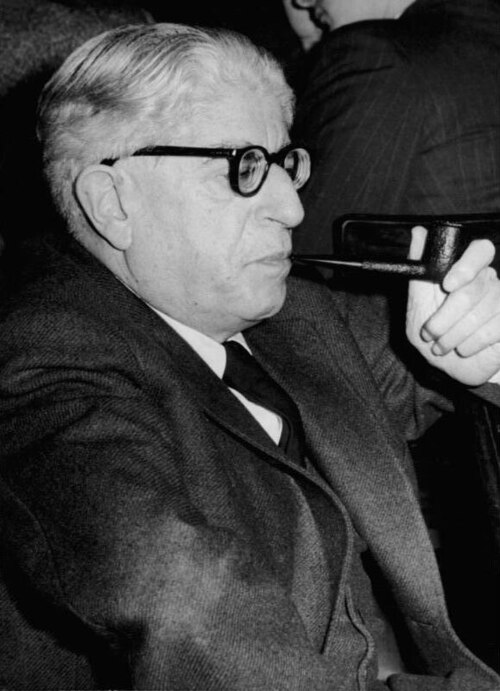
Ernst Simon Bloch was a German Marxist philosopher. Bloch was influenced by Georg Wilhelm Friedrich Hegel and Karl Marx, as well as by apocalyptic and religious thinkers such as Thomas Müntzer, Paracelsus, and Jacob Böhme. He established friendships with György Lukács, Bertolt Brecht, Kurt Weill, Walter Benjamin, and Theodor W. Adorno. Bloch's work focuses on an optimistic teleology of the history
"In the same society in which the processes of production and distribution will go on far out at the circumference, the essential human concerns will move to the center, to the end, into the teleological questions of "where to" and "what for."
"Gramscis remarks are rich and stimulating, but in the last analysis they follow the classical Marxist pattern of analysing religion. Ernst Bloch was the first Marxist author who radically changed the theoretical framework—without abandoning the Marxist and revolutionary perspective. In a similar way to Engels, he distinguished two socially opposed currents: on one side the theocratic religion of the official churches, opium of the people, a mystifying apparatus at the service of the powerful; on the other the underground, subversive and heretical religion of the Albigensians, the Hussites, Joachim di Fiori, Thomas Münzer, Franz von Baader, Wilhelm Weitling and Leo Tolstoy."
"Desgleichen kann es ... keinem Zweifel unterliegen, daß die unterschiedslos ideologische Verdächtigung jeder Idee, ohne Bedürfnis, selbst eine zu exaltieren, das Lichtere nicht ermutigt."
"How absurd it must seem for an immortal soul to be destined for Heaven or Hell, and yet be sitting in a kitchen, as a maid, or to see oneself objectified as a mechanic! how falsely the usual sunrise waked us, the clock dial, the city street the job! How wrongfully people find themselves in these systems — our time isnt there, our space isnt there, our space isnt even here... the whole social story of waking, and certainly the day of the mechanic, is false."
"Denn wir müssen sterben, mit kurzem Verzug, und vielleicht brauchen die Leichen keinen so weiten Faltenwurf, den Weg alles Fleisches zu gehen. Der brüderlich innere Reichtum wird nicht minder kurzer Spuk, verwest zu Baumrinde wie Rübezahls falsche Schätze: zeigt sich in ihm keine Kraft, gar den Tod zu bestehen, zu besiegen, mithin nicht nur von unten an hindurch zu gehen, sondern auch an sich selbst ein kräftig oberer Teil zu sein und das Wesenselement des ewigen Lebens."
"Jesus own coming was by no means so introverted and other-worldly as a Pauline reinterpretation—always welcome to the ruling class—would have it. ... To Jesus, the kingdom of this world was the devil (John 8:44). This is why he never suggested allowing it to go on; he did not conclude a non-aggression pact with it."