SHAWORDS

In physics, the thinker Kanada, explained light and heat as different — Kanaada

HomeKanaadaQuote
"In physics, the thinker Kanada, explained light and heat as different aspects of the same element, thus anticipating Clarke Maxwells Electro-magnetic Theory, which unified different forms of radiant energy. Sankaracharya, in his Advaita thought expanded the concept of unity of matter and energy. Vacaspati recognized light as composed of minute particles emitted by substances, anticipating Newton’s Corpuscular Theory of Light and the later discovery of the Photon. In Botany, Sankara Mishra and Kanada have discussed the circulation of sap in the Plant and the Santiparva of Mahabharata has clearly stated that the plants develop on the strength of nutrients made through interaction of sunlight and materials obtained from the air and ground. Bhaskarcharyas concept of Differential Calculus preceded Newton by many centuries. His study of time identified Truti: The 3400th part of a second as the unit of time."
Kanaada
Kanaada
Kaṇāda
author4 quotes

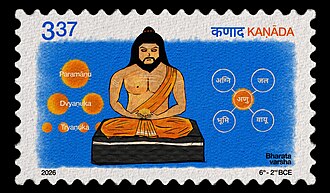
Kanaada, also known as Kanabhaksha, Kanabhuj was an ancient Indian natural scientist and philosopher who founded the Vaisheshika school of Indian philosophy that also represents the earliest Indian physics

More by Kanaada

View all →
Quote
"Two systems of Hindu thought propound physical theories suggestively similar to those of Greece. Kanada, founder of the Vaisheshika philosophy, held that the world was composed of atoms as many in kind as the various elements. The Jains more nearly approximated to Democritus by teaching that all atoms were of the same kind, producing different effects by diverse modes of combination. Kanada believed light and heat to be varieties of the same substance; Udayana taught that all heat comes from the sun; and Vachaspati, like Newton, interpreted light as composed of minute particles emitted by substances and striking the eye."
KanaadaKanaada
Quote
"As Gautama is the Aristotle of India, so Kanada is its Democritus. His name, which means the “atom-eater,” suggests that he may be a legendary construct of the historical imagination. The date at which the Vaisheshika system was formulated has not been fixed with excessive accuracy: we are told that it was not before 300 B.C., and not after 800 A.D. Its name came from vishesha, meaning particularity: the world, in Kanada’s theory, is full of a number of things, but they are all, in some form, mere combinations of atoms; the forms change, but the atoms remain indestructible. Thoroughly Democritean, Kanada announces that nothing exists but “atoms and the void,” and that the atoms move not according to the will of an intelligent deity, but through an impersonal force or law — Adrishta, “the invisible.” Since there is no conservative like the child of a radical, the later exponents of Vaisheshika, unable to see how a blind force could give order and unity to the cosmos, placed a world of minute souls alongside the world of atoms, and supervised both worlds with an intelligent God.66 So old is the “pre-established harmony” of Leibnitz."
KanaadaKanaada
Quote
"To be at the height of their calling, men of Science have to reject the very possibility of Materialistic doctrines having aught to do with the Atomic Theory; and we find that Lange, Butlerof, Du Bois Reymond—the last probably unconsciously—and several others, have proved it. And this is, furthermore, demonstrated by the fact, that Kanâda in India, and Leucippus and Democritus in Greece, and after them Epicurus—the earliest Atomists in Europe—while propagating their doctrine of definite proportions, believed in Gods or supersensuous Entities, at the same time. Their ideas upon Matter thus differed from those now prevalent... the Atomic Theory kills Materialism."
KanaadaKanaada