SHAWORDS

Is the Airship Possible? That depends, first of all, on whether we are — Simon Newcomb

"Is the Airship Possible? That depends, first of all, on whether we are to make the requisite scientific discoveries... the construction of an aerial vehicle ... which could carry even a single man from place-to-place at pleasure requires the discovery of some new metal or some new force."
Simon Newcomb
Simon Newcomb
Simon Newcomb
author7 quotes

Simon Newcomb was a Canadian–American astronomer, applied mathematician, and autodidactic polymath. He served as Professor of Mathematics in the United States Navy and at Johns Hopkins University. Born in Nova Scotia, at the age of 19 Newcomb left an apprenticeship to join his father in Massachusetts, where the latter was teaching.

More by Simon Newcomb

View all →
Quote
"One of the most curious of these cases [geometrical paradoxers] was that of a student, I am not sure but a graduate, of the University of Virginia, who claimed that geometers were in error in assuming that a line had no thickness. He published a school geometry based on his views, which received the endorsement of a well-known New York school official and, on the basis of this, was actually endorsed, or came very near being endorsed, as a text-book hi the public schools of New York."
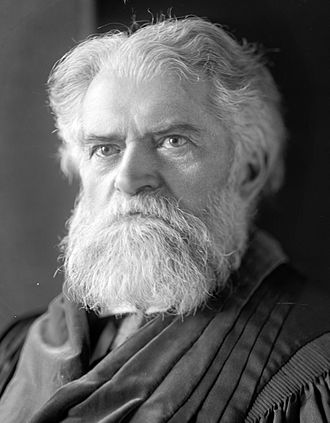
Simon NewcombSimon Newcomb
Quote
"Professor Fishers The Purchasing Power of Money is dedicated to Simon Newcomb, from whom vid Professor Kemmerer the PT = MV formula ultimately derives. Newcomb was not a professional economist but a mathematician (Professor of Mathematics in the U.S. Navy and at Johns Hopkins). His Principles of Political Economy, published in 1886, is one of those original works which a fresh scientific mind, not perverted by having read too much of the orthodox stuff, is able to produce from time to time in a half -formed subject like economics."
Simon NewcombSimon Newcomb
Quote
"There is no difference between Time and any of the three dimensions of Space except that our consciousness moves along it. ...space, as our mathematicians have it, is spoken of as having three dimensions, which one may call Length, Breadth, and Thickness, and is always definable by reference to these planes, each at right angle to the others. But some philosophical people have been asking why three dimensions particularly—why not another direction at right angles to the other three?—and have even tried to construct a Four Dimensional geometry. Professor Simon Newcomb was expounding this to the New York Mathematical Society only a month or so ago. You know how on a flat surface, which has only two dimensions, we can represent a figure of a Three-Dimensional solid, and similarly they think that by models of three dimensions they could represent one of four—if they could master the perspective of the thing. See?"
Simon NewcombSimon Newcomb
Quote
"In the late 19th century, Newcomb was one of America’s best known and probably one of its most powerful scientists. He had spent most of his career as a professor at the naval observatory in Washington, D. C. He had served as President of the American Academy of Arts and Science and as President of the Political Economy Club in the 1880s. He eventually received numerous awards for his most important astronomical research more accurately measuring the movements of the moon and the planets in our solar system. In the 1880s, Newcomb joined the faculty of Johns Hopkins University and his views regarding the competence of junior faculty were often communicated to President Daniel Gilman. This was especially the case for Peirce and Ely. Newcomb also confronted America’s most prominent theologians on the relationship between theology and science and of course evolution and Christianity. For the nation’s centennial, Newcomb also had offered his harsh appraisals of American science and political economy maintaining that they were way behind European science and British political economy. Newcomb also thwarted Peirce’s career progress on numerous occasions playing a pivotal role in his exclusion from academia after 1885."
Simon NewcombSimon Newcomb