Quote
"As India must be bled the lancet should be directed to the parts where the blood is congested or at least sufficient, not to those (the agricultural people) which are already feeble from the want of it."
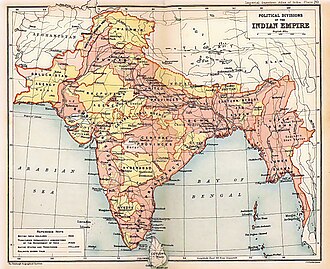 British Raj
"It is commonly said that it was the Mahomedans whom the British displaced as rulers in India. This is true only in a restricted sense. It would be nearer the truth to say that it was the Mahrattas in the main, whom we displaced."
The British Raj was the rule of the British Crown on the Indian subcontinent, lasting from 1858 to 1947. It is also called Crown rule in India, or direct rule in India. The region under British control was commonly called India in contemporaneous usage and included areas directly administered by the United Kingdom, which were collectively called British India, and areas ruled by indigenous rulers,
"As India must be bled the lancet should be directed to the parts where the blood is congested or at least sufficient, not to those (the agricultural people) which are already feeble from the want of it."
British Raj"Our nations have mutually destroyed each other on that very soil where we went to collect nothing but money, and where the first Greeks travelled for nothing but knowledge."
British Raj"He spoke very bitterly of the attempts of the English and Mohammedans to civilize the country by the bayonet and fire and sword. English civilization was composed of the three "Bs" - Bible, bayonet, and brandy. "That is civilization, and it has been carried to such an extent that the average income of a Hindu is 50 cents a month. Russia is outside, saying. Lets civilize a little, and England goes on and on."
British Raj"Why is it that the principles of Government and lessons of history which we have learnt in our experience with the great self-governing dominions, which we have learnt in Canada, in South Africa and in Ireland, apply only in a limited degree to India? It is because the problem of Indian government is primarily a technical one. In India far more than in any other community in the world moral, political and economic considerations are outweighed by the importance of technical and administrative apparatus. Here you have nearly three hundred and fifty millions of people, lifted to a civilisation and to a level of peace, order, sanitation and progress far above anything they could possibly have achieved themselves or could maintain. This wonderful fact is due to the guidance and authority of a few thousands of British officials responsible to Parliament who have for generations presided over the development of India. If that authority is injured or destroyed, the whole efficiency of the services, defensive, administrative, medical, hygienic, judicial; railway, irrigation, public works and famine prevention, upon which the Indian masses depend for their culture and progress, will perish with it. India will fall back quite rapidly through the centuries into the barbarism and privations of the Middle Ages. The question at stake is not therefore the gratification of the political aspirations towards self-government of a small number of intellectuals. It is, on the contrary, the practical, technical task of maintaining the peace and life of India by artificial means upon a much higher standard than would otherwise be possible. To let the Indian people fall, as they would, to the level of China, would be a desertion of duty on the part of Great Britain."
British Raj"The British were perhaps the most successful pirates in history. They came to India, pillaged the country in the name of trade and then enslaved it in the name of civilization."
British Raj"The British Government in India has not only deprived the Indian people of their freedom, but has debased it economically, politically, culturally, and spiritually. We believe that India must sever the British connection and attain purna swarajya, or complete independence...We hold it to be a crime against man and God to submit any longer to the rule that has caused this disaster to our country. We recognize, however, that the most effective way of gaining our freedom is not through violence."
British Raj