SHAWORDS

It is not murder which is forgiven but the killer, his person as it ap — Hannah Arendt

"It is not murder which is forgiven but the killer, his person as it appears in circumstances and intentions. The trouble with the Nazi criminals was precisely that they renounced voluntarily all personal qualities, as if nobody were left to be either punished or forgiven. They protested time and again that they had never done anything out of their own initiative, that they had no intentions whatsoever, good or bad, and that they only obeyed orders."
Hannah Arendt
Hannah Arendt
Hannah Arendt
author

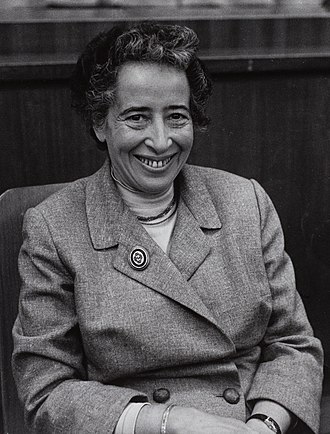
Hannah Arendt was a German and American historian and philosopher. She was one of the most influential political theorists of the twentieth century.

More by Hannah Arendt

View all →
Quote
"It is characteristic of the Oxford school of criticism to understand these [metaphysical] fallacies as logical non sequiturs—as though philosophers throughout the centuries had been, for reasons unknown, just a bit too stupid to discover the elementary flaws in their arguments. The truth of the matter is that elementary logical mistakes are quite rare in the history of philosophy; what appear to be errors in logic to minds disencumbered of questions that have been uncritically dismissed as “meaningless” are usually caused by semblances, unavoidable for beings whose whole existence is determined by appearance. Hence, In our context the only relevant question is whether the semblances are inauthentic or authentic ones, whether they are caused by dogmatic beliefs and arbitrary assumptions, mere mirages that disappear upon closer inspection, or whether they are inherent in the paradoxical condition of a living being that, though itself part of the world of appearances, is in possession of a faculty, the ability to think, that permits the mind to withdraw from the world without ever being able to leave it or transcend it."
Hannah ArendtHannah Arendt
Quote
"The totalitarian attempt at global conquest and total domination has been the destructive way out of all impasses. Its victory may coincide with the destruction of humanity; wherever it has ruled, it has begun to destroy the essence of man. Yet to turn our backs on the destructive forces of the century is of little avail. The trouble is that our period has so strangely intertwined the good with the bad that without the imperialists "expansion for expansions sake," the world might never have become one; without the bourgeoisies political device of "power for powers sake," the extent of human strength might never have been discovered; without the fictitious world of totalitarian movements, in which with unparalleled clarity the essential uncertainties of our time have been spelled out, we might have been driven to our doom without ever becoming aware of what has been happening. And if it is true that in the final stages of totalitarianism an absolute evil appears (absolute because it can no longer be deduced from humanly comprehensible motives), it is also true that without it we might never have known the truly radical nature of Evil."
Hannah ArendtHannah Arendt