SHAWORDS

It is precisely in knowing its limits that philosophy consists. — Immanuel Kant

"It is precisely in knowing its limits that philosophy consists."
Immanuel Kant
Immanuel Kant
Immanuel Kant
author

Immanuel Kant was a German philosopher. Born in Königsberg in the Kingdom of Prussia, he is considered one of the central thinkers of the Enlightenment. His comprehensive and systematic works in epistemology, metaphysics, logic, ethics, aesthetics, political theory, and the philosophy of religion have made him one of the most influential and highly discussed figures in modern Western philosophy.

More by Immanuel Kant

View all →
Quote
"Phenomena of the external sense are examined and set forth in physics; those of the internal sense in empirical psychology. Pure mathematics considers space in geometry and time in pure mechanics. To these is to be added a certain concept, intellectual to be sure in itself, but whose becoming actual in the concrete requires the auxiliary notions of time and space in the successive addition and simultaneous juxtaposition of separate units, which is the concept of number treated in arithmetic."
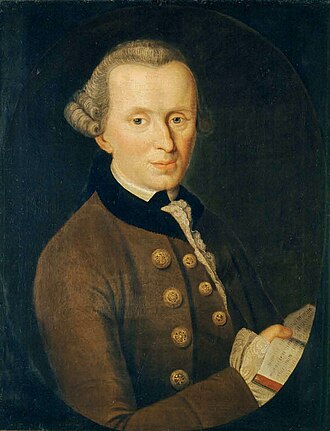
Immanuel KantImmanuel Kant
Quote
"they cudgel their brains with absurd questions, such as, for instance, why God did not make the world many centuries earlier. They persuade themselves that it is easy to conceive, to be sure, how God may discern what is present, that is, what is actual in the time in which he is, but how He may foresee what is future, that is, what is actual in the time in which He is not yet, they deem an intellectual difficulty; as if the existence of the Necessary Being descended through all the moments of an imaginary time, and, having already exhausted a part of His duration, saw before Him the eternity He was yet to live simultaneously with the present events of the world. All these difficulties upon proper insight into the notion of time vanish like smoke."
Immanuel KantImmanuel Kant
Quote
"As everybody likes to be honoured, so people imagine that God also wants to be honoured. They forget that the fulfilment of duty towards men is the only honour adequate to him. Thus is formed the conception of a religion of worship, instead of a merely moral religion. … Apart from moral conduct, all that man thinks himself able to do in order to become acceptable to God is mere superstition and religious folly. If once a man has come to the idea of a service which is not purely moral, but is supposed to be agreeable to God himself, or capable of propitiating him, there is little difference between the several ways of serving him. For all these ways are of equal value. … Whether the devotee accomplishes his statutory walk to the church, or whether he undertakes a pilgrimage to the sanctuaries of Loretto and Palestine, whether he repeats his prayer-formulas with his lips, or like the Tibetan, uses a prayer-wheel … is quite indifferent. As the illusion of thinking that a man can justify himself before God in any way by acts of worship is religious superstition, so the illusion that he can obtain this justification by the so-called intercourse with God is religious mysticism (Schwärmerei). Such superstition leads inevitably to sacerdotalism (Pfaffenthum) which will always be found where the essence is sought not in principles of morality, but in statutory commandments, rules of faith and observances."
Immanuel KantImmanuel Kant
Quote
"The use of the intellect in the sciences whose primitive concepts as well as axioms are given by sensuous intuition is only logical, that is, by it we only subordinate cognitions to one another according to their relative universality conformably to the principle of contradiction, phenomena to more general phenomena, and consequences of pure intuition to intuitive axioms. But in pure philosophy, such as metaphysics, in which the use of the intellect in respect to principles is real, that is to say, where the primary concept of things and relations and the very axioms are given originally by the pure intellect itself, and not being intuitions do not enjoy immunity from error, the method precedes the whole science, and whatever is attempted before its precepts are thoroughly discussed and firmly established is looked upon as rashly conceived and to be rejected among vain instances of mental playfulness."
Immanuel KantImmanuel Kant