Quote
"The Franklin sold at £4. 6s, each at the furnace, and at Philadelphia £18 per ton, the price varying with the metal."
 Metal
Metal"It seemed probable that the large activity of some of these minerals, compared with and , was due to the presence of small quantities of some very active substance, which was different from the known bodies thorium and uranium. This supposition was completely verified by the work of M. and Mme Curie, who were able to separate from pitchblende by purely chemical methods two active bodies, one of which in the pure state is over a million times more active than the metal uranium. This important discovery was due entirely to the property of radio-activity possessed by the new bodies. The only guide in their separation was the activity of the products obtained. ...The activity of the specimens thus served as a basis of rough qualitative and quantitative analysis, analogous in some respects to the indication of the spectroscope."
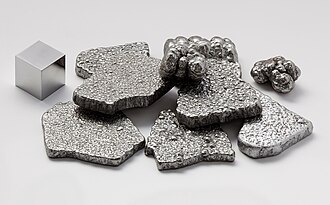
A metal is a material that, when polished or fractured, shows a lustrous appearance, and conducts electricity and heat relatively well. These properties are all associated with having electrons available at the Fermi level, as opposed to nonmetallic materials which do not. Metals are typically ductile and malleable.
"The Franklin sold at £4. 6s, each at the furnace, and at Philadelphia £18 per ton, the price varying with the metal."
Metal"Nothing can vex the Devil more Than the name of him whom we adore. Therefore doth it delight me best To stand in the choir among the rest, With the great organ trumpeting Through its metallic tubes, and sing: Et verbum caro factum est! [And the Word was made flesh!] These words the devil cannot endure, For he knoweth their meaning well! Him they trouble and repel, Us they comfort and allure, And happy it were, if our delight Were as great as his affright!"
Metal", The Story of the Chemical Elements (1897) pp. 16-19."
Metal"Scheele discovered in 1781; and soon after a metal was extracted from it by Messrs. [Fausto & Juan José] D Elhuyars."
Metal"Although no great stress can be laid on numbers so obtained, they serve to indicate that Davy had not yet obtained the pure metal."
Metal"Mercury doesnt contribute its valence electrons readily to the [electron] soup. The thinner soup cant bind the mercury atoms together very strongly. Mercury atoms easily slip past and away from each other. Heat easily overcomes the weak binding between mercury atoms, and mercury boils and melts at lower temperatures than any other metal. Because the valence electron soup is thinner for mercury, its electrical and thermal conductivity are poor."
Metal