SHAWORDS

It took us some more time, though, to learn that April Glaspie may hav — Gulf War

HomeGulf WarQuote
"It took us some more time, though, to learn that April Glaspie may have tricked Hussein into invading Kuwait to provide that causus belli, and that the Kuwaiti girl crying on Capitol Hill during testimony about Iraqi ‘crimes’ in Kuwait (such as killing babies in incubators) was pure propaganda, created by a PR firm to boost public support for the war. It took people even more time to learn that the USA, after urging the Shi’a of the south of Iraq to rebel, were abandoned and left to slaughter by Saddam Hussein’s returning forces."
Gulf War
Gulf War
Gulf War
author

The Gulf War was an armed conflict between Iraq and a 42-country coalition led by the United States. The coalition's efforts were in two phases: Operation Desert Shield, which marked the military buildup from August 1990 to January 1991; and Operation Desert Storm, from the bombing campaign against Iraq on 17 January until the American-led liberation of Kuwait on 28 February.

More by Gulf War

View all →
Quote
"A Texas firefighting team today extinguished the first of 500 oil-well fires set by Iraqi troops and declared a "small victory" that could mark a turning point in the operation. The team from a Houston-based company, Boots & Coots, using liquid nitrogen and water, put out a relatively small fire on its second attempt this morning. "I think its very important," Boots Hansen, the boss of the firefighting team, said of the achievement. He said the method -- injecting nitrogen into the fire through a large cylinder attached to a giant bulldozer while spraying water at the base of the cylinder -- was less time-consuming than other methods, like the use of dynamite. "Its a small victory," said Larry Flak, a Houston oil engineer coordinating the entire firefighting effort. "Now we can go from well to well to well without a lot of rigging up or preparation." Mr. Hansen estimated that the nitrogen method, which deprives the fire of needed oxygen, could probably be used on half the fires set by the Iraqis late in February, before allied ground troops drove them from Kuwait."
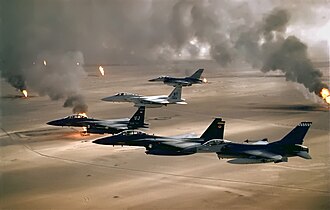
Gulf WarGulf War
Quote
"Our concern over possible use of weapons of mass destruction against U.S. forces in the Middle East has increased because Iraq has violated the Geneva Protocol of 1925 and the 1972 Biological Weapons Convention, attempted to acquire nuclear capability and delivery systems, and is reported to be developing biological weapons. The Army Medical Department has had no experience, since World War I, in the management and treatment of mass casualties contaminated by chemical agents, and has never treated casualties resulting from the use of nuclear or biological weapons used against our soldiers. Management and diagnosis of casualties will be complicated by their possible exposure to a mixture of chemical warfare and biological warfare agents. Triage is an essential aspect in the management of mass casualties since the number of injured patients will exceed the maximum medical capability to treat each patient on arrival. All levels of medical support must be prepared to protect themselves, their equipment and supplies, and their patients from contamination. In contaminated operations on the integrated battlefield, it will be of utmost importance to incorporate flexibility and innovation to match the medical and tactical situation."
Gulf WarGulf War
Quote
"Just as in Pakistan, where Zia had to repeatedly, continuously subjugate critics with violence to stay on top, so Hezbollah would have to repeatedly beat down opponents. In July 1990, just months before the official end of the war in Lebanon, thousands demonstrated in Tyre. “We want to speak the truth!” they chanted. “We don’t want to see any Iranians!” Lebanese Shia clerics called for the end of the “Iranian invasion” and the departure of the Revolutionary Guards who had come to the Beqaa Valley after the 1982 Israeli invasion and still maintained a presence. But the Guards could in fact leave; Hezbollah, their local affiliate, was in place. And by allowing Assad to send troops into Lebanon, America had unwittingly provided a way for his ally Iran to maintain its foothold on the Mediterranean. The black wave from Iran would not recede."
Gulf WarGulf War
Quote
"A small but recurrent component of media reports on Iraq and Kuwait during the period from the Iraq invasion of Kuwait on 2 August 1990 through the Gulf War and its aftermath dealt with archaeology in the region and the potential and actual impact of the war on archaeological remains. An index of the saliece of archaeology for formulating the meaning of the war is that one of the first editorials printed in the New York Times the day after the bombing of Baghdad began (19 Jan. 1991) centered on thus subject. Entitled The Cradle, Ironically, of Civilization, it warned the US military against bombing cities, religious shrines or renowned archaeological sites but went on to focus entirely on the prehistoric sites. It used descriptors that were to recur constantly throughout media coverage of the arhcaeology of the region, describing Ur, for example, as the very cradle of civilization and the birthplace of Abraham, and evoking images of ancient, unexplored, and sacred cities scattered through Iraq. Why did archaeological remains have this centrality? In a society still; enamored of an evolutionary view of human societies, did the story of a glorious Iraqi past get its power through the devolutionary reversals it displayed, its clear legitimizing unction for an avenging Allied campaign to preserve or even restore what was referred to as our common heritage? Did ancient artifacts, like incubator babies of Kuwait, allow for narratives of innocence in a story that was otherwise too full of moral responsibility - with evil or invisible Iraqis, noble Allies and victimized Kuwaitis? Or, has the fetishizing of the commodity in our society grown over time to such a point that artifact survivors become more important that human Iraqi ones?"
Gulf WarGulf War