Quote
"Character is the result of a system of stereotyped principles."
D
David Hume"It was a fixed maxim in this reign, as well as in some of the subsequent, that no native of the island should ever be advanced to any dignity, ecclesiastical, civil, or military. The king therefore, upon Stigands deposition, promoted Lanfranc, a Milanese monk, celebrated for his learning and piety, to the vacant see. This prelate was rigid in defending the prerogatives of his station; and after a long process before the pope, he obliged Thomas, a Norman monk, who had been appointed to the see of York, to acknowledge the primacy of the archbishop of Canterbury. Where ambition can be so happy as to cover its enterprizes, even to the person himself, under the appearance of principle, it is the most incurable and inflexible of all human passions. Hence Lanfrancs zeal in promoting the interests of the papacy, by which he himself augmented his own authority, was indefatigable; and met with proportionable success. The devoted attachment to Rome continually encreased in England; and being favoured by the sentiments of the conquerors, as well as by the monastic establishments formerly introduced by Edred and by Edgar, it soon reached the same height, at which it had, during some time, stood in France and Italy. It afterwards went much farther; being favoured by that very remote situation, which had at first obstructed its progress; and being less checked by knowledge and a liberal education, which were still somewhat more common in the southern countries."
David Hume was a Scottish philosopher, historian, economist and essayist who is known for his highly influential system of empiricism, philosophical scepticism and metaphysical naturalism. Beginning with A Treatise of Human Nature (1739–40), Hume strove to create a naturalistic science of man that examined the psychological basis of human nature. Hume followed John Locke in rejecting the existence
"Character is the result of a system of stereotyped principles."
"Truth springs from argument amongst friends."
"I say, then, that belief is nothing but a more vivid, lively, forcible, firm, steady conception of an object, than what the imagination alone is ever able to attain"
"In every page of David Hume, there is more to be learned than from Hegels, Herbarts and Schleiermachers complete philosophical works."
"Tis certainly a kind of indignity to philosophy, whose sovereign authority ought every where to be acknowledgd, to oblige her on every occasion to make apologies for her conclusions, and justify herself to every particular art and science, which may be offended at her."
"The great end of all human industry, is the attainment of happiness. For this were arts invented, sciences cultivated, laws ordained, and societies modelled, by the most profound wisdom of patriots and legislators."
"In the life of the mass-order, the culture of the generality tends to conform to the demands of the average human being. Spirituality decays through being diffused among the masses when knowledge is impoverished in every possible way by rationalisation until it becomes accessible to the crude understanding of all."
"I say this to you because we Spaniards are a forgetful people, because we are used to living for the moment, because we do not look back, because we do not know how to see the chain of heroes, because we do not contemplate the sum of sacrifices."
 Francisco Franco
"Sharon Tate was my best friend. Once, we were roommates. She introduced me to my husband. She was the godmother to my baby daughter who is named for her. In the six years time that I knew her, she never said an unkind word about anyone."
"Long time to see. (VS: Tapion)"
"Most mathematicians prove what they can, von Neumann proves what he wants." Once in a discussion about the rapid growth of mathematics in modern times, von Neumann was heard to remark that whereas thirty years ago a mathematician could grasp all of mathematics, that is impossible today. Someone asked him: "What percentage of all mathematics might a person aspire to understand today?" Von Neumann went into one of his five-second thinking trances, and said: "About 28 percent."
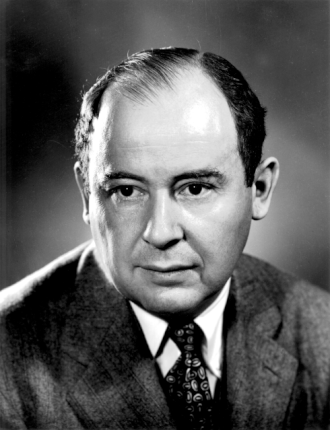 John von Neumann
"Children must be free to think in all directions irrespective of the peculiar ideas of parents who often seal their childrens minds with preconceived prejudices and false concepts of past generations. Unless we are very careful, very careful indeed, and very conscientious, there is still great danger that our children may turn out to be the same kind of people we are."