Quote
"The power to become habituated to his surroundings is a marked characteristic of mankind."
J
John Maynard Keynes"Keynes turned the question back again. He started thinking in Ricardo’s terms: output as a whole and why worry about a cup of tea? When you are thinking about output as a whole, relative prices come out in the wash — including the relative price of money and labour. The price level comes into the argument, but it comes in as a complication, not as the main point. If you have had some practice on Ricardo’s bicycle you do not need to stop and ask yourself what to do in a case like that, you just do it. You assume away the complication till you have got the main problem worked out. So Keynes began by getting money prices out of the way. Marshall’s cup of tea dissolved into thin air. But if you cannot use money, what unit of value do you take? A man hour of labour time. It is the most handy and sensible measure of value, so naturally you take it. You do not have to prove anything, you just do it."
John Maynard Keynes, 1st Baron Keynes, was an English economist whose writings are considered the basis for the school of thought known as Keynesian economics, as well as its various offshoots. Originally trained in mathematics, he built on and refined earlier work on the causes of business cycles. His ideas, further developed after his death as New Keynesianism, are seen as foundational to mainst
"The power to become habituated to his surroundings is a marked characteristic of mankind."
"The duty of "saving" became nine-tenths of virtue and the growth of the cake the object of true religion."
"Leninism is a combination of two things which Europeans have kept for some centuries in different compartments of the soul — religion and business. We are shocked because the religion is new, and contemptuous because the business, being subordinated to the religion instead of the other way round, is highly inefficient."
"But when we come to consider the problem of party positively—by what attracts... the aspect is dismal in every party alike, whether we put our hopes in measures or in men. ...The historic party questions of the nineteenth century are as dead as last weeks mutton; and whilst the questions of the future are looming up, they have not yet become party questions, and they cut across the old party lines."
"I see us free, therefore, to return to some of the most sure and certain principles of religion and traditional virtue – that avarice is a vice, that the exaction of usury is a misdemeanour, and the love of money is detestable, that those walk most truly in the paths of virtue and sane wisdom who take least thought for the morrow. We shall once more value ends above means and prefer the good to the useful. We shall honour those who can teach us how to pluck the hour and the day virtuously and well, the delightful people who are capable of taking direct enjoyment in things, the lilies of the field who toil not, neither do they spin."
"But the dreams of designing diplomats do not always prosper, and we must trust the future."
"In the life of the mass-order, the culture of the generality tends to conform to the demands of the average human being. Spirituality decays through being diffused among the masses when knowledge is impoverished in every possible way by rationalisation until it becomes accessible to the crude understanding of all."
"I say this to you because we Spaniards are a forgetful people, because we are used to living for the moment, because we do not look back, because we do not know how to see the chain of heroes, because we do not contemplate the sum of sacrifices."
 Francisco Franco
"Sharon Tate was my best friend. Once, we were roommates. She introduced me to my husband. She was the godmother to my baby daughter who is named for her. In the six years time that I knew her, she never said an unkind word about anyone."
"Long time to see. (VS: Tapion)"
"Most mathematicians prove what they can, von Neumann proves what he wants." Once in a discussion about the rapid growth of mathematics in modern times, von Neumann was heard to remark that whereas thirty years ago a mathematician could grasp all of mathematics, that is impossible today. Someone asked him: "What percentage of all mathematics might a person aspire to understand today?" Von Neumann went into one of his five-second thinking trances, and said: "About 28 percent."
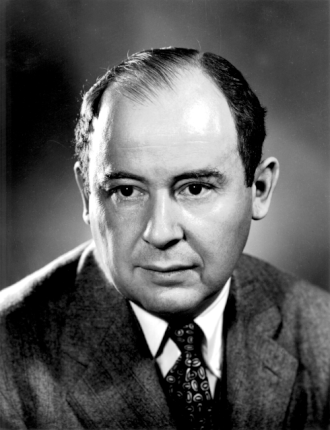 John von Neumann
"Children must be free to think in all directions irrespective of the peculiar ideas of parents who often seal their childrens minds with preconceived prejudices and false concepts of past generations. Unless we are very careful, very careful indeed, and very conscientious, there is still great danger that our children may turn out to be the same kind of people we are."