Quote
"This māyā, that is to say, the ego, is like a cloud. The sun cannot be seen on account of a thin patch of cloud; when that disappears one sees the sun. If by the grace of the guru ones ego vanishes, then one sees God."
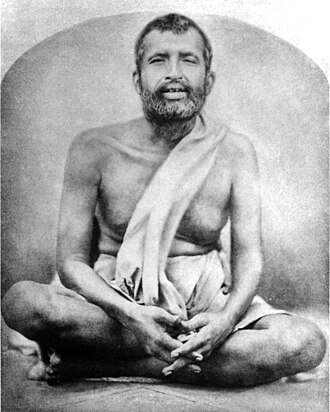 Ramakrishna
"Knowledge leads to unity, but Ignorance to diversity. So long as God seems to be outside and far away, there is ignorance. But when God is realised within, that is true knowledge."
Ramakrishna, also called Ramakrishna Paramahamsa, born Ramakrishna Chattopadhyay, was an Indian Hindu mystic. He was a devotee of the goddess Kali, but adhered to various religious practices from the Hindu traditions of Vaishnavism, Tantric Shaktism, and Advaita Vedanta, as well as Christianity and Sufi Islam. His parable-based teachings advocated the essential unity of religions and proclaimed th
"This māyā, that is to say, the ego, is like a cloud. The sun cannot be seen on account of a thin patch of cloud; when that disappears one sees the sun. If by the grace of the guru ones ego vanishes, then one sees God."
Ramakrishna"Chant the name of God and sing his glories unceasingly; and keep holy company. Now and then one should visit holy men and devotees of God. If a man lives in the world and busies himself day and night with worldly duties and responsibilities, he cannot give his mind to God. So its important to go into solitude from time to time, and think about God. When the plant is young, it should be fenced on all sides. Unless theres a fence around it, goats and cattle may eat it up. When you meditate, go into the solitude of a forest, or a quiet corner, and enter into the chamber of your heart. And always keep your power of discrimination awake. God alone is real, that is to say, eternal; everything else is unreal, because it will pass away. As you discriminate in this manner, let your mind give up its attachment to the fleeting objects of this world. … Attend to all your duties but keep your mind fixed on God. Wife, son, father, mother — live with all of them and serve them, as if they were your very own. But know in your heart of hearts that they are not your own."
Ramakrishna"Many are the names of God, and infinite the forms that lead us to know Him. In whatsoever name or form you desire to call Him, in that very form and name you will see Him."
Ramakrishna"He who is called Brahman by the jnanis is known as Atman by the yogis and as Bhagavan by the bhaktas. The same brahmin is called priest, when worshipping in the temple, and cook, when preparing a meal in the kitchen. The jnani, following the path of knowledge, always reason about the Reality saying, "not this, not this." Brahman is neither "this" nor "that"; It is neither the universe nor its living beings. Reasoning in this way, the mind becomes steady. Finally it disappears and the aspirant goes into samadhi. This is the Knowledge of Brahman. It is the unwavering conviction of the jnani that Brahman alone is real and the world is illusory. All these names and forms are illusory, like a dream. What Brahman is cannot be described. One cannot even say that Brahman is a Person. This is the opinion of the jnanis, the followers of Vedanta. But the bhaktas accept all the states of consciousness. They take the waking state to be real also. They dont think the world to be illusory, like a dream. They say that the universe is a manifestation of the Gods power and glory. God has created all these — sky, stars, moon, sun, mountains, ocean, men, animals. They constitute His glory."
Ramakrishna"God laughs on two occasions. He laughs when the physician says to the patients mother, "Dont be afraid, mother; I shall certainly cure your boy." God laughs, saying to Himself, "I am going to take his life, and this man says he will save it!" The physician thinks he is the master, forgetting that God is the Master. God laughs again when two brothers divide their land with a string, saying to each other, "This side is mine and that side is yours." He laughs and says to Himself, "The whole universe belongs to Me, but they say they own this portion or that portion."
Ramakrishna"Man cannot really help the world. God alone does that — He who has created the sun and the moon, who has put love for their children in parents hearts, endowed noble souls with compassion, and holy men and devotees with divine love. The man who works for others, without any selfish motive, really does good to himself. There is gold buried in your heart, but you are not yet aware of it. It is covered with a thin layer of earth. Once you are aware of it, all these activities of yours will lessen. … Through selfless work, love of God grows in the heart. Then, through His grace, one realizes Him in course of time. God can be seen, one can talk to Him, as I am talking to you."
Ramakrishna