SHAWORDS

Lo, while his majesty sat talking with the princes, the vanquished chi — Ramesses II

HomeRamesses IIQuote
"Lo, while his majesty sat talking with the princes, the vanquished chief of Kheta came and the numerous countries, which were with him. They crossed over the channel on the south of Kadesh, and charged into the army of his majesty while they were marching, and not expecting it. Then the infantry and chariotry of his majesty retreated before them, northward to the place where his majesty was. Lo, the foes of the vanquished chief of Kheta surrounded the bodyguard of his majesty, who were by his side."
Ramesses II
Ramesses II
Ramesses II
author13 quotes

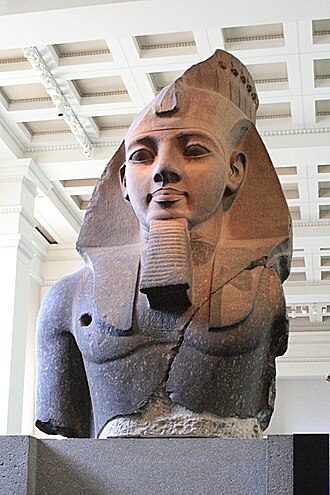
Ramesses II, commonly known as Ramesses the Great, was the third pharaoh of the Nineteenth Dynasty of Egypt. Ramesses II is regarded as the greatest, most celebrated, and most powerful pharaoh of the New Kingdom, which itself was the most powerful period of ancient Egypt. He is also widely considered one of ancient Egypt's most successful warrior pharaohs, conducting no fewer than 15 military camp

More by Ramesses II

View all →
Quote
"Sesostris was the only Egyptian king who also ruled Ethiopia. To commemorate his name, he set before the temple of Hephaestus two stone statues of himself and his wife, each thirty cubits high, and statues of his four sons, each of twenty cubits. Long afterwards Darius the Persian would have set up his statue before these; but the priest of Hephaestus forbade him, saying that he had achieved nothing equal to the deeds of Sesostris the Egyptian; for Sesostris (he said) had subdued the Scythians, besides as many other nations as Darius had conquered, and Darius had not been able to overcome the Scythians; therefore it was not just that Darius should set his statue before the statues of Sesostris, whose achievements he had not equalled. Darius, it is said, let the priest have his way."
Ramesses IIRamesses II
Quote
"Ramses II; he made (it) as his monument for his father, Amon-Re, making for him a great and august broad-hall of fine white sandstone, its nave of great flower-columns, surrounded by bud-columns: a place of rest for the lord of gods at his beautiful "Feast of the Valley"; that he might, through him, be given life ——— shaping his sacred barque like the horizon-god, founding daily offerings, doing the things which please his father, causing that his house should be for him like Thebes, supplied with every good thing, granaries reaching heaven, an august treasury containing silver, gold, royal linen, every real costly stone, which King Ramses II brought for him."
Ramesses IIRamesses II
Quote
"Ten stades from the first tombs, he says, in which, according to tradition, are buried the concubines of Zeus, stands a monument of the king known as Osymandyas.​ At its entrance there is a pylon, constructed of variegated stone, two plethra in breadth and forty-five cubits high; passing through this one enters a rectangular peristyle, built of stone, four plethra long on each side; it is supported, in place of pillars, by monolithic figures sixteen cubits high, wrought in the ancient manner as to shape; and the entire ceiling, which is two fathoms wide, consists of a single stone, which is highly decorated with stars on a blue field. Beyond this peristyle there is yet another entrance and pylon, in every respect like the one mentioned before, save that it is more richly wrought with every manner of relief; beside the entrance are three statues, each of a single block of black stone from Syene, of which one, that is seated, is the largest of any in Egypt,​ the foot measuring over seven cubits, while the other two at the knees of this, the one on the right and the other on the left, daughter and mother respectively, are smaller than the one first mentioned. And it is not merely for its size that this work merits approbation, but it is also marvellous by reason of its artistic quality and excellent because of the nature of the stone, since in a block of so great a size there is not a single crack or blemish to be seen. The inscription upon it runs: "King of Kings am I, Osymandyas. If anyone would know how great I am and where I lie, let him surpass one of my works." There is also another statue of his mother standing alone, a monolith twenty cubits high, and it has three diadems on its head, signifying that she was both daughter and wife and mother of a king."
Ramesses IIRamesses II
Quote
"On the temples there are a few sparse hairs, but at the poll the hair is quite thick, forming smooth, straight locks about five centimeters in length. White at the time of death, and possibly auburn during life, they have been dyed a light red by the spices (henna) used in embalming ... the moustache and beard are thin. ... The hairs are white, like those of the head and eyebrows ... the skin is of earthy brown, splotched with black ... the face of the mummy gives a fair idea of the face of the living king."
Ramesses IIRamesses II
Quote
"In Egypt’s sandy silence, all alone, Stands a gigantic Leg, which far off throws The only shadow that the Desert knows:— “I am great OZYMANDIAS,” saith the stone, “The King of Kings; this mighty City shows The wonders of my hand.”—The City’s gone,— Naught but the Leg remaining to disclose The site of this forgotten Babylon. We wonder,—and some Hunter may express Wonder like ours, when thro’ the wilderness Where London stood, holding the Wolf in chace, He meets some fragment huge, and stops to guess What powerful but unrecorded race Once dwelt in that annihilated place."
Ramesses IIRamesses II