SHAWORDS

Mendeleev... set about writing a book aimed at summarizing all of inor — Dmitri Mendeleev

"Mendeleev... set about writing a book aimed at summarizing all of inorganic chemistry. It was while writing this book that he identified the organizing principle... the periodic system of the elements."
Dmitri Mendeleev
Dmitri Mendeleev
Dmitri Mendeleev
author21 quotes

Dmitri Ivanovich Mendeleev was a Russian chemist known for formulating the periodic law and creating a version of the periodic table of elements. He used the periodic law not only to correct the then-accepted properties of some known elements, such as the valence and atomic weight of uranium, but also to predict the properties of three elements that were yet to be discovered. The synthetic element

More by Dmitri Mendeleev

View all →
Quote
"1. The elements, if arranged according to their atomic weights, exhibit an evident periodicity of properties. 2. Elements which are similar as regards their chemical properties have atomic weights which are either of nearly the same value (e.g., platinum, iridium, osmium) or which increase regularly (e.g., potassium, rubidium, caesium). 3. The arrangement of the elements, or of groups of elements in the order of their atomic weights corresponds to their so-called valencies as well as, to some extent, to their distinctive chemical properties--as is apparent among other series in that of lithium, beryllium, barium, carbon, nitrogen, oxygen and iron [sic. The printed speech in J. Chem. Soc. says barium and iron. Obviously boron (B) and fluorine (F) are meant. Mendeleevs 1869 paper lists the symbols B and F rather than the names of the elements.--CJG] 4. The elements which are the most widely diffused have small atomic weights. 5. The magnitude of the atomic weight determines the character of the element just as the magnitude of the molecule determines the character of a compound body. 6. We must expect the discovery of many yet unknown elements, for example, elements analogous to aluminium and silicon, whose atomic weight would be between 65 and 75. 7. The atomic weight of an element may sometimes be amended by a knowledge of those of the contiguous elements. Thus, the atomic weight of tellurium must lie between 123 and 126, and cannot be 128. 8. Certain characteristic properties of the elements can be foretold from their atomic weights. ...[R]elations ...exist between the atomic weights of dissimilar elements ...hitherto ...neglected. I believe that the solution of some of the most important problems of our science lies in researches of this kind. To-day, 20 years after the above conclusions were formulated, they may still be considered as expressing the essence of the now well-known periodic law."
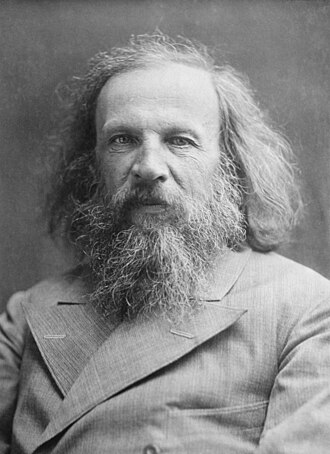
Dmitri MendeleevDmitri Mendeleev
Quote
"He made up a pack of cards and wrote an element and its atomic weight on each... So began the most memorable card game in the history of science. He called it "chemical solitaire" and began laying out the cards... to see if there was a pattern... [P]reviously chemists had grouped the elements in one of two ways, either by their properties... or by... their atomic weight, which is what Berzelius and Cannizzaro had done. Mendeleevs great genius was to combine those two methods together. ...Little more than half the elements ...had been discovered, so he was playing with an incomplete deck of cards. He stayed up for three days and three nights without... sleep... finally dozed off... [and] had an extraordinary dream. He saw almost all of the 63 known elements... in a grand table which related them together."
Dmitri MendeleevDmitri Mendeleev
Quote
"The distinction would only come to Mendeleev halfway through writing his Principles of Chemistry. ...chemical practice and not chemical theory had provided his initial organizing principle... Up to this point [Chapter 20], Mendeleev had only treated four elements in any detail: oxygen, carbon, nitrogen, and hydrogen—the so-called "organogens." Mendeleev began this chapter as usual by purifying the central substance, sodium chloride, from sources such as seawater. A discussion of sodium and chlorine followed in the next few chapters, and finally the halogens appeared... that were closely related to chlorine... and the alkali metals (the sodium family) form the first chapter of volume 2. ...he had dealt with only 8 elements, relegating 55... to the second volume. ...Mendeleevs earlier system of pedalogically useful organization—using laboratory practices... could no longer sustain the burden of exposition. He needed a new system... and he hit upon the idea of using a numerical marker for each element. Atomic weight seemed the most likely candidate for a system that would (a) account for all remaining elements; (b) do so in limited space; and (c) maintain some pedagogical merit. His solution, the periodic system, remains one of the most useful tools in chemistry."
Dmitri MendeleevDmitri Mendeleev