SHAWORDS

Non-alignment" provided a way in which the leaders of "third world" st — Yugoslavia

HomeYugoslaviaQuote
"Non-alignment" provided a way in which the leaders of "third world" states could tilt without toppling: the idea was to commit to neither side in the Cold War, but to leave open the possibility of such commitment. That way, if pressure from one superpower became too great, a smaller power could defend itself by threatening to align with the other superpower. Yugoslavia—not a "third world" state—pioneered the process. Tito had not sought Stalins condemnation in 1948: he was, and remained, a dedicated communist. But he was determined not to sacrifice sovereignty for the sake of ideological solidarity, and unlike most other East European leaders at the time, he had no need to do so. Noting how quickly the Americans offered him economic assistance after his break with Stalin, Tito saw the possibility of a lifeline: would the Russians risk using force against the Yugoslavs if this might lead to war with the Americans? With the United States Sixth Fleet operating just off the long Yugoslav coast, there were good reasons for Stalin to think twice about attempting an invasion, and there is evidence that he did so, contenting himself instead with assassination plots—all of them unsuccessful."
Yugoslavia
Yugoslavia
Yugoslavia
author14 quotes

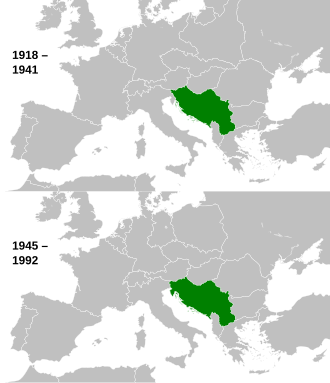
Yugoslavia was a country in Central Europe and the Balkans that existed from 1918 to 1992. It came into existence following World War I, under the name of the Kingdom of Serbs, Croats and Slovenes, from the merger of the Kingdom of Serbia with the provisional State of Slovenes, Croats and Serbs, and constituted the first union of South Slavic peoples as a sovereign state, following centuries of fo

More by Yugoslavia

View all →
Quote
"But its not the Serbs or Croats or Bosnians who are guilty. In Yugoslavia the problems began for the same reason as in the U.S.S.R. The communists--they had Tito, we had Lenin and Stalin--charted out arbitrary, ethnically nonsensical and historically unjustifiable internal administrative boundaries, and for years moved inhabitants from one region to another. And when--also in the period of a few days--Yugoslavia began to fall apart, the leading powers of the West, with inexplicable haste and irresponsibility, rushed to recognize these states within their artificial borders. Therefore, for the exhausting, bloody war which is today convulsing the unfortunate peoples of the former Yugoslavia, the leaders of the Western powers must share the blame with Tito. Now, attempting to somehow correct the very problem they helped to create, they essentially repeat the well-known maxim of Metternich [the backward-looking Hapsburg diplomat who dominated the post-Napoleonic Congress of Vienna in the early 19th century] for the Holy Alliance: "Intervention for the sake of making others healthy." Today the slogan is "Intervention for the sake of humanism." It is an ironic similarity! But intervention is a very dangerous thing. It is not so easy for the great powers to control the world."
YugoslaviaYugoslavia
Quote
"This heroic aspect of the Partisan struggle, deeply inspiring to scholars-turned-soldiers like Deakin, reads well on the page. But in practice of waging a politico-military campaign over the length and breadth of Yugoslavia brought untold suffering to its peoples. Their history was already one of bitter and violent rivalry, which the war had reawoken. In the north leaders of the Catholic Croats had taken advantage of Italian sponsorship to unleash a campaign of expulsion, forced conversion, and extermination against the Orthodox Serbs. Muslims in Bosnia-Herzegovina took a hand in the civil war also, while in the south the Serbs of Kosovo were attacked by their Albanian neighbors. The Chetniks, for their part, contested authority in the Serb lands with the Partisans, with whom they had failed to agree a join strategy, but did not open war with the German occupiers lest that provoke reprisals. Tito hardened his heart against reprisals; indeed, he saw Axis atrocities as a spur to recruitment. He deliberately drew the Germans after him in seven so-called offensives that left the countryside through which his Partisans marched a wasteland. The villagers had either to follow the Partisans into the woods (a traditional description of the whereabouts of resisters to the Turks) or stay and await reprisals. Kardelji, Titos deputy, was emphatic about the desirability of confronting the uncommitted with such a dilemma: Some commanders are afraid of reprisals and that fear prevents the mobilisation of villages. I consider the reprisals will have the useful result of throwing Croatian villages on the side of Serb villages. In war we must not be frightened of the destruction of whole villages. Terror will bring about armed action. Kardeljis analysis was correct."
YugoslaviaYugoslavia
Quote
"Yugoslavia - initially known as The Kingdom of the Serbs, Croats and Slovenes, which named only three of the countrys seventeen or more ethnic groups - was another hodgepodge. The Serbs had dreamed of a South Slav kingdom that they would dominate; as if to make that point, the new states constitution was promulgated on June 28, 1921, the anniversary of the Battle of Kosovo and of the Archduke Francis Ferdinands assassination. In reality, Yugoslavia was an uneasy amalgam not just of Croats, Serbs and Slovenes, but also of Albanians, Bosnian Muslims, Montenegrins, Macedonians and Turks - not to mention Czechs, Germans, Gypsies, Hungarians, Italians, Jews, Romanians, Russians, Slovaks and Ukrainians."
YugoslaviaYugoslavia
Quote
"The fact that Serbian-dominated Yugoslavia emerged as one of the victor states of the war seemed implicitly to vindicate the act of the man who pulled the trigger on 28 June – certainly that was the view of the Yugoslav authorities, who marked the spot where he did so with bronze footprints and a plaque celebrating the assassin’s ‘first steps into Yugoslav freedom’. In an era when the national idea was still full of promise, there was an intuitive sympathy with South Slav nationalism and little affection for the ponderous multinational commonwealth of the Hapsburg Empire. The Yugoslav wars of the 1990s have reminded us of the lethality of Balkan nationalism. Since Srebrenica and the siege of Sarajevo, It has become harder to think of Serbia as the mere object or victim of great power politics and easier to conceive of Serbian nationalism as an historical force in its own right. From the perspective of today’s European Union we are inclined to look more sympathetically – or at least less contemptuously – than we used to on the vanished imperial patchwork of Austria-Hungary."
YugoslaviaYugoslavia