Quote
"Latin is a dead language, As dead as it can be; It killed the ancient Romans, And now is killing me."
 Latin
Latin"Often, what is not collected becomes lost or at least unappreciated. This principle holds true to an extent for the neglect that all of Medieval Latin literature has suffered in publishing over the past century. Classical Latin literature has been gathered into series, which, although not always as inexpensive as potential users might wish, are nonetheless affordable. Consider the rows of blue-backed Oxford Classical Texts or the serried red ranks of the Latin volumes in the Loeb Classical Library."
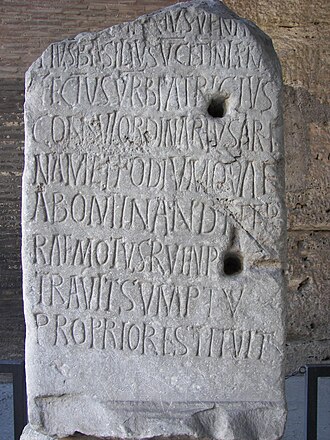
Latin is a classical language belonging to the Italic branch of the Indo-European languages. Latin was originally spoken by the Latins in Latium, the lower Tiber area around Rome, Italy. Through the expansion of the Roman Republic, it became the dominant language in the Italian Peninsula and subsequently throughout the Roman Empire. It has greatly influenced many languages, including English, havi
"Latin is a dead language, As dead as it can be; It killed the ancient Romans, And now is killing me."
Latin"To preserve Latin literature inevitably meant preserving classical mythology."
Latin"The official language used across the Roman Empire was Latin. This did not mean that every person from Antioch to St. Albans spoke to one another in the epigrams of Martial: the classical Latin of the great Roman poets, philosophers and historians was of no more use to ordinary day-to-day speakers than the syntax and vocabulary of Shakespeare’s sonnets would have been to an innkeeper or goatherd in Elizabethan England. In the east of the empire, Latin competed with Greek for the position of the most prevalent, admirable and useful language, particularly after the empire was formally partitioned in the early fourth century. In the west, Latin was adopted, adapted, and interbred with local tongues across the empire – a process that produced what would eventually become the great Romance languages of the second millennium AD. But if it was not exactly a universal tongue, Latin certainly was the first language of imperial business, which allowed educated Romans everywhere to communicate with one another and to advertise their status as sophisticated beings. Learning Latin – and the skills of grammar and rhetoric – formed an elemental part of elite education. It was not possible to contemplate a political or bureaucratic career without a working knowledge of the language. And to the priests, abbots, chancellors, scholars, lawyers, sheriffs, schoolteachers, nobles and kings of the Middle Ages, Latin would also become an indispensable tool."
Latin