Quote
"I am eternally, devastatingly romantic, and I thought people would see it because romantic doesnt mean sugary. Its dark and tormented — the furor of passion, the despair of an idealism that you cant attain."
 Romanticism
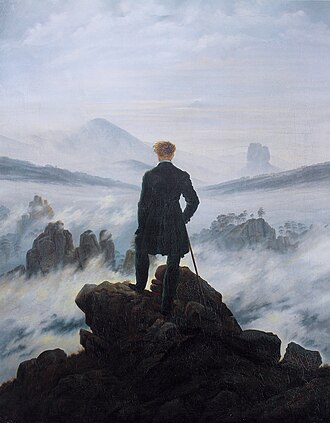
"On the surface there was a strong monarchical, rightist, and "medievalist" reaction to be felt all over Europe; Chateaubriand, de Maistre, de Bonald, Schlegel, E. T. A. Hoffmann, Zacharias Werner, Clemens Brentano, the brothers Stolberg and Manzoni wrote their great works within this movement. Romanticism east of the Rhine was truly diversitarian and romantic. A wave of conversions swept over the Continent and the Tractarian movement in England was not far off. The Church seemed to regain her old influence. Yet, under the surface, the nationalists of the herdist pattern would render all efforts of the spiritual-intellectual elite illusory. The vast masses of Slav inhabitants of the East European plains began to raise their voices in favor of a union. And from the northwestern plains and islands another monster raised its head, another phenomenon bound to change the face of the earth — the Industrial Revolution. While Kaspar David Friedrich and Kriehuber painted mountain scenes and Schwind and Ludwig Richter dwelt on the subtle lore of small German towns, tall chimneys and great machines, heralding the advent of another scourge, made their appearance; while poets, painters, and princes spoke in glowing terms of the coming New Middle Ages a German of Jewish descent, horrified and bewildered by the spectacle of British industrialism, first conceived the ideas which a few years later led to the publication of the "Communist Manifesto."
Romanticism was an artistic and intellectual movement that originated in Europe towards the end of the 18th century. The purpose of the movement was to advocate for the importance of subjectivity, imagination, and appreciation of nature in society and culture in response to the Age of Enlightenment and the Industrial Revolution.
"I am eternally, devastatingly romantic, and I thought people would see it because romantic doesnt mean sugary. Its dark and tormented — the furor of passion, the despair of an idealism that you cant attain."
Romanticism"What was the Romantic School in Germany? It was nothing else but the reawakening of the poetry of the Middle Ages, as it had shown itself in its songs, images, and architecture, in art and in life."
Romanticism"No realist can love romantic Art so much as he loves his own, but when that Art fulfils the laws of its peculiar being, if he would be no blind partisan, he must admit it. The romanticist will never be amused by realism, but let him not for that reason be so parochial as to think that realism, when it achieves vitality, is not Art. For what is Art but the perfected expression of self in contact with the world; and whether that self be of enlightening, or of fairy-telling temperament, is of no moment whatsoever. The tossing of abuse from realist to romanticist and back is but the sword-play of two one-eyed men with their blind side turned toward each other. Shall not each attempt be judged on its own merits? If found not shoddy, faked, or forced, but true to itself, true to its conceiving mood, and fair-proportioned part to whole; so that it lives — then, realistic or romantic, in the name of Fairness let it pass! Of all kinds of human energy, Art is surely the most free, the least parochial; and demands of us an essential tolerance of all its forms. Shall we waste breath and ink in condemnation of artists, because their temperaments are not our own?"
Romanticism"The essential elements ... of the romantic spirit are curiosity and the love of beauty."
Romanticism"[R]omanticism is the feeling that man is not the mere he has always taken himself for. Romanticism began as a tremendous surge of optimism about the stature of man. Its aim — like that of science — was to raise man above the muddled feelings and impulses of his everyday humanity, and to make him a god-like observer of human existence."
Romanticism"Romanticism is precisely situated neither in choice of subject nor exact truth, but in the way of feeling."
Romanticism