Quote
"It is not characteristic of American executives to read books, except books on management and mysteries. ... Those who who do venture into this arena ... are looked upon by their colleagues with mingled awe and incredulity."
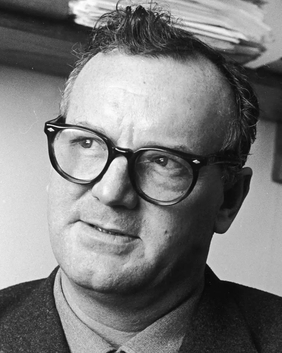 C. Wright Mills
"One great lesson that we can learn from its systematic absence in the work of the grand theorists is that every self-conscious thinker must at all times be aware of — and hence be able to control — the levels of abstraction on which he is working. The capacity to shuttle between levels of abstraction, with ease and with clarity, is a signal mark of the imaginative and systematic thinker."
Charles Wright Mills was an American sociologist, and a professor of sociology at Columbia University from 1946 until his death in 1962. Mills published widely in both popular and intellectual journals, and is remembered for several books, such as The Power Elite, White Collar: The American Middle Classes, and The Sociological Imagination. Mills was concerned with the responsibilities of intellect
"It is not characteristic of American executives to read books, except books on management and mysteries. ... Those who who do venture into this arena ... are looked upon by their colleagues with mingled awe and incredulity."
C. Wright Mills"In a public, as we may understand the term, (1) virtually as many people express opinions as receive them, (2) Public communications are so organised that there is a chance immediately and effectively to answer back any opinion expressed in public. Opinion formed by such discussion (3) readily finds an outlet in effective action, even against – if necessary – the prevailing system of authority. And (4) authoritative institutions do not penetrate the public, which is thus more or less autonomous in its operations.-In a mass, (1) far fewer people express opinions than receive them; for the community of publics becomes an abstract collection of individuals who receive impressions from the mass media. (2) The communications that prevail are so organised that it is difficult or impossible for the individual to answer back immediately or with any effect. (3) The realisation of opinion in action is controlled by authorities who organise and control the channels of such action. (4) The mass has no autonomy from institutions; on the contrary, agents of authorised institutions penetrate this mass, reducing any autonomy it may have in the formation of opinion by discussion."
C. Wright Mills"The ideals of liberalism have been divorced from any realities of modern social structure that might serve as the means of their realization. ... The detachment of liberalism from the facts of a going society make it an excellent mask for those who do not, cannot, or will not do what would have to be done to realize its ideals."
C. Wright Mills"Those in authority within institutions and social structures attempt to justify their rule by linking it, as if it were a necessary consequence, with moral symbols, sacred emblems, or legal formulae which are widely believed and deeply internalized. These central conceptions may refer to a god or gods, the votes of the majority, the will of the people, the aristocracy of talents or wealth, to the divine right of kings or to the alleged extraordinary endowment of the person of the ruler himself."
C. Wright Mills"The personality market, the most decisive effect and symptom of the great salesroom, underlies the all pervasive distrust and self-alienation so characteristic of metropolitan people. Without common values and mutual trust, the cash nexus that links one man to another in transient contact has been made subtle in a dozen ways, and made to bite deeper into all areas of life and relations. People are required by the salesman ethic and convention to pretend interest in others in order to manipulate them. In the course of time, and as this ethic spreads, it is got on to. Still, it is conformed to as part of ones job and ones style of life, but now with a winking eye, for one knows that manipulation is inherent in every human contact. Men are estranged from one another as each secretly tries to make an instrument of the other, and in time a full circle is made: one makes an instrument of himself and is estranged from it also."
C. Wright Mills"America - a conservative country without any conservative ideology - appears now before the world a naked and arbitrary power, as, in the name of realism, its men of decision enforce their often crackpot definitions upon world reality. The second-rate mind is in command of the ponderously spoken platitude. In the liberal rhetoric, vagueness, and in the conservative mood, irrationality, are raised to principle. Public relations and the official secret, the trivializing campaign and the terrible fact clumsily accomplished, are replacing the reasoned debate of political ideas in the privately incorporated economy, the military ascendancy, and the political vacuum of modern America."
C. Wright Mills"The wound is the place where the Light enters you."
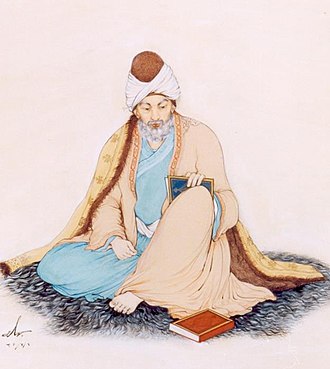 Rumi
Rumi"Be the change that you wish to see in the world."
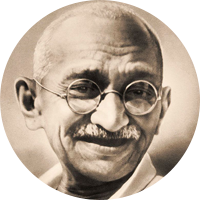 Mahatma Gandhi
"In philosophy equally as in poetry it is the highest and most useful prerogative of genius to produce the strongest impressions of novelty, while it rescues admitted truths from the neglect caused by the very circumstance of their universal admission."
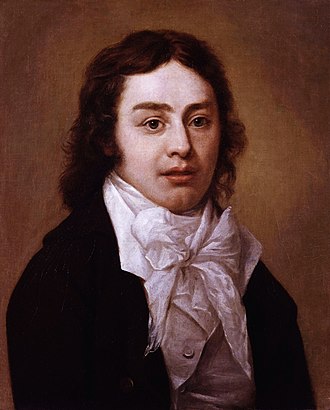 Samuel Taylor Coleridge
"An [hypertext] encyclopaedia will be an overall attempt by the knowledgeable, the learned societies or anyone else, to represent the state-of-the-art in their field. An encyclopaedia will be a living document, as up to date as it can be, instantly accessible at any time. It will contain carefully authored explanations and summaries of the subject, as well as computer-generated indexes of literature. A reference to a paper from the encyclopaedia conveys authority and acceptance by academic society. A measure of a paper’s standing may be conveyed by the number of links it is away from an encyclopaedia."
 Tim Berners-Lee
"The British intellectual tradition is empirical and liberal, the French is rationalist and aristocratic, and the German is idealist and conservative. ...In the great ontological debate between mind and matter, German philosophy comes down solidly on the side of mind. Its emphasis is intuition as opposed to reason, ideas as opposed to facts."
"To know the mighty works of God, to comprehend His wisdom and majesty and power; to appreciate, in degree, the wonderful workings of His laws, surely all this must be a pleasing and acceptable mode of worship to the Most High, to whom ignorance cannot be more grateful than knowledge."