Quote
"Ramsey: At the Naval War College it was metallurgy and nuclear reactors, not 19th-century philosophy."
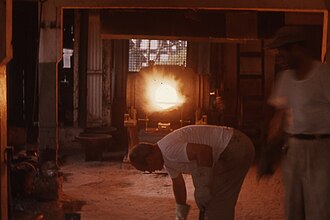 Metallurgy
"Peter Venkman: Ray, for a moment, pretend that I dont know anything about metallurgy, engineering, or physics, and just tell me what the hell is going on."
Metallurgy is a domain of materials science and engineering that studies the physical and chemical behavior of metallic elements, their inter-metallic compounds, and their mixtures, which are known as alloys.
"Ramsey: At the Naval War College it was metallurgy and nuclear reactors, not 19th-century philosophy."
Metallurgy"For my financial interest in the greatest metallurgical concern in Germany, the United Steel Works, instead of being transferred to the Reich, has been seized by . Goering may have certain ideas in this connection. Indeed, a large share ownership in these steel works might save the Hermann Goering Works from bankruptcy."
Metallurgy"The swords made in India were prized all over the world. The sword of Tipu Sultan is almost a legend. These facts have rarely been mentioned or brought to the notice in the publications on history of metallurgy..."
Metallurgy"The art of tempering and casting iron developed in India long before its known appearance in Europe; , for example, erected at Delhi (ca. 380 A.D.) an iron pillar that stands untarnished today after fifteen centuries; and the quality of metal, or manner of treatment, which has preserved it from rust or decay is still a mystery to modern metallurgical science. Before the European invasion the smelting of iron in small charcoal furnaces was one of the major industries of India. The Industrial Revolution taught Europe how to carry out these processes more cheaply on a larger scale, and the Indian industry died under the competition. Only in our own time are the rich mineral resources of India being again exploited and explored."
Metallurgy"In the history of war and society we single out three main innovations to describe significant changes before 1800: the introduction of metal, when humans abandoned stone weapons for ones made from bronze and iron; the domestication of the horse, which gave warriors greater mobility and speed; and the introduction of gunpowder, which transformed war on land and at sea. (Since other parts of the world, such as the Americas, did not have horses until the Europeans brought them in the sixteenth century and some parts of the world, such as Australia, never developed metal weapons, not all human societies have experienced change at the same time.) In each case, of course, many other things were happening both to technology and to society. Metal weapons were only a part of the story: societies had to develop the soldiers and the infrastructures to make use of them. Horses were more formidable when the wheel enabled them to pull chariots or later on when they could carry armed warriors. The introduction of gunpowder too was accompanied by other important developments: in metallurgy, for example, so that guns did not explode when they were fired, or in the design and navigation of ships, so that they could make use of the new cannon."
Metallurgy"The export of into Italy was strictly forbidden; but aluminium was almost the only metal that Italy produced in quantities beyond her own needs. The importation of scrap iron and into Italy was sternly vetoed in the name of public justice. But as the Italian metallurgical industry made but little use of them, and as steel billets and were not interfered with, Italy suffered no hindrance. Thus, the measures pressed with so great a parade were not real sanctions to paralyse the aggressor, but merely such half-hearted sanctions as the aggressor would tolerate, because in fact, though onerous, they stimulated Italian war spirit. The League of Nations, therefore, proceeded to the rescue of Abyssinia on the basis that nothing must be done to hamper the invading Italian armies. These facts were not known to the British public at the time of the election. They earnestly supported the policy of the sanctions, and believed that this was a sure way of bringing the Italian assault upon Abyssinia to an end."
Metallurgy