Quote
"There is no Heaven, no Swarga, no Hell, no rebirth, no reincarnation and no immortality. The only thing that is true is that a man is born, he lives and he dies. Therefore, he should live his life properly."
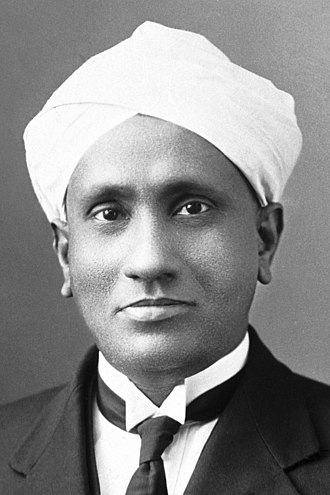 C. V. Raman
"Purposeful life needs an axis or hinge to which it is firmly fixed and yet around which it can freely revolve. As I see it, this axis or hinge has been, in my own case, strongly enough, not the love of science, not even the love of Nature but a certain abstract idealism or belief in the value of the human spirit and the virtue of human endeavour and achievement. The nearest point to which I can trace this source of idealism in my recollection of reading Edwin Arnolds great book, The Light of Asia. I remember being powerfully moved by the story of Siddhartahs great renunciation, of his search for truth and of his final enlightenment."
Chandrasekhara Venkata Raman was an Indian physicist known for his work in the field of light scattering. Using a spectrograph that he developed, he and his student K. S. Krishnan discovered that when light traverses a transparent material, the deflected light changes its wavelength. This phenomenon, a hitherto unknown type of scattering of light they called modified scattering, was subsequently t
"There is no Heaven, no Swarga, no Hell, no rebirth, no reincarnation and no immortality. The only thing that is true is that a man is born, he lives and he dies. Therefore, he should live his life properly."
C. V. Raman"Man of science seeks to resolve the links between art, aesthetics, and the science. The man of science …seeks to resolve [nature’s] infinite complexities in to a few simple principles or elements of action which he calls the laws of nature. In doing this , like the exponents of other forms of art, subjects himself to a rigorous discipline, the rules of which he had laid down for himself and which he calls logic …. Science… Is a fusion of man’s aesthetic and intellectual functions devoted to the representations of nature. It is therefore the highest form of creative art."
C. V. Raman"When the Nobel award was announced I saw it as a personal triumph, an achievement for me and my collaborators -- a recognition for a very remarkable discovery, for reaching the goal I had pursued for 7 years. But when I sat in that crowded hall and I saw the sea of western faces surrounding me, and I, the only Indian, in my turban and closed coat, it dawned on me that I was really representing my people and my country. I felt truly humble when I received the Prize from King Gustav; it was a moment of great emotion but I could restrain myself."
C. V. Raman"The pages of Euclid are like the opening bars of the music of the Grand Opera of Natures great drama. So to say, they lift the veil and show to our vision a glimpse of a vast world of natural knowledge awaiting study."
C. V. Raman"Then I turned round and saw the British Union Jack under which I had been sitting and it was then that I realised that my poor country, India, did not even have a flag of her own - and it was this that triggered off my complete breakdown."
C. V. Raman"Look at the resplendent colours on the soap bubbles! Why is the sea blue? What makes diamond glitter! Ask the right questions, and nature will open the doors to her secrets"
C. V. Raman