Quote
"I came to see a king, not a row of corpses."
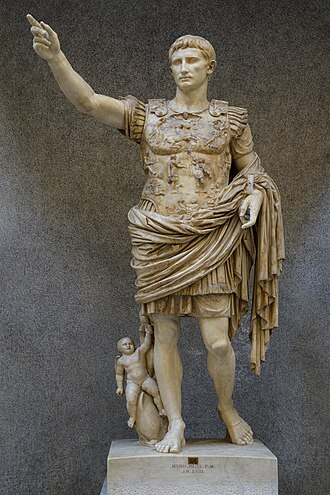 Augustus
"Quintili Vare, legiones redde!"
Caesar Augustus, also known as Octavian, was the founder of the Roman Empire and the first Roman emperor from 27 BC until his death in AD 14. The reign of Augustus initiated an imperial cult and an era of imperial peace in which the Roman world was largely free of armed conflict. The principate, a style of government where the emperor showed nominal deference to the Senate, was established during
"I came to see a king, not a row of corpses."
Augustus"He could not even stand up to review his fleet when the ships were already at their fighting stations, but lay on his back and gazed up at the sky, never rising to show that he was alive until Marcus Agrippa had routed the enemy."
Augustus"Sat celeriter fieri, quidquid fiat satis bene."
Augustus"Si sine uxore pati possemus, Quirites, omnes ea molestia careremus; set quoniam ita natura tradidit, ut nec cum illis satis commode, nec sine illis ullo modo vivi possit, saluti perpetuae potius quam brevi voluptati consulendum est."
Augustus"Have I played the part well? Then applaud as I exit."
Augustus"Augustus pursued power relentlessly and then clung to it, whatever he might pretend in public. Such ambition is surely the hallmark of any successful political leader – and no doubt plenty of less successful ones. Yet in his case he made use of that power for the common good. He worked hard to make the res publica function again, and we cannot deny that he succeeded, since the peace and stability he imposed brought ever greater levels of prosperity. At a basic level more people were better-off under his principate than they had been for several generations. The concerns he dealt with were traditional ones, even if some of his methods were innovative. Julius Caesar had tried to address several of these issues, as had others, but none had the chance to deal with them as thoroughly as Augustus. In the process he made sure that it was well known that he was working for the common good, but once again such advertising was what any Roman politician would have done. By doing favours for individuals and whole communities he placed them in his debt, and so, as so often, personal advantage was intertwined with the wider good. That does not alter the fact that he did rule well, whatever his motivation."
Augustus