Quote
"Well I know what Ive been told Youve to break free to break the mold But I cant do this all on my own No, I cant do this all on my own I know, that Im no Superman."
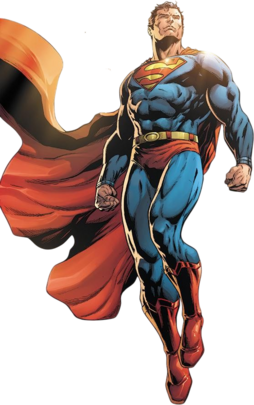 Superman
"So Jerry and Joe plucked elements from the world around them to stir into their Superman stew. For the most part however, Superman’s millions of fans would ignore his origins. For them the Man of Steel would simply be the defender of the little man and woman-and a big problem for the forces of evil in the world."
Superman is a superhero created by writer Jerry Siegel and artist Joe Shuster, first appearing in issue #1 of Action Comics, published in the United States on April 18, 1938. Superman has been regularly published in American comic books published by DC Comics since then, and has been adapted to other media including radio serials, novels, films, television shows, theater, and video games. Superman
"Well I know what Ive been told Youve to break free to break the mold But I cant do this all on my own No, I cant do this all on my own I know, that Im no Superman."
Superman"Rather than Clark be this clownish suit that Superman puts on, were going to really see Clark come into his own in the next few years as far as being a guy who takes to the Internet and to the airwaves and starts speaking an unvarnished truth."
Superman"I didnt bother getting into it with Tarantino about the Superman thing, because its not really true," chuckles Carradine. "Its not unique. The idea that Supermans analysis, whatever you want to call it, his image of the human race is Clark Kent, weak, a coward, fumbling, wearing glasses, uncertain of himself, not able to get a girl, all those kinds of things. Thats his idea about us and thats the point that Tarantino was trying to make. But the idea of Superman being unique in that he was born Superman, which is another point that Tarantinos trying to make, that thats what these people [Bill, etc.] are, these people are born warriors and they cant help it, but theres also the Silver Surfer, right? And theres Sub-Mariner..."
Superman"Superman has always defended vulnerable communities and he’s always been political, says Joseph Darowski, a professor at Brigham Young University. Darowski is also a comic historian and the editor of “The Ages of Superman: Essays on the Man of Steel in Changing Times.” “It’s an inevitable part of the comic book industry that politics is going to seep in,” Darowski says. “There’s always some reflection of what’s going on on the world stage.” In the 1940s, Superman tried to stop World War II. He’s taken on corrupt politicians and got political during the Cold War, too. “As America gets engaged in the space race, suddenly Superman’s enemies are coming from the stars more frequently,” Darowski says. “Kryptonite and other forms of radiation creeps into the stories after the dropping of the atomic bomb. During the Cold War and the nuclear arms race, Kryptonite becomes much more commonly used in Super-man stories, and villains who get their power through radiation also become much more common. These geopolitical events end up being adapted in fantastic ways into the Superman comics.”"
Superman"Everyone’s like, ‘He’s so powerful, I can’t relate to him.’ Are you kidding me? He’s the most relatable character ever. He grew up on a farm, he doesn’t have a lot of friends, feels isolated, he can’t tell everybody what his secrets are. He’s a great character. He feels overlooked — who hasn’t felt overlooked, or wanted to connect with people? All social media is, is people wanting to connect with other people. That’s all it is. Because people long to connect with other people. And Superman is the embodiment of that. He’s more relevant now than ever."
Superman"A man who can see across the planet and wring diamonds from its anthracite."
Superman