Quote
"死神の附いた耳へは、意見も道理も入るまいとは思へど、さりとは愚痴の至り"
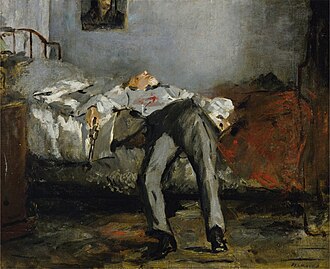 Suicide
"Suicide can often be consistent with self-interest and with one’s duty to oneself; this can’t be questioned by anyone who accepts that age, sickness, or misfortune may make life a burden that is even worse than annihilation. I don’t believe that anyone ever threw away his life while it was worth keeping. Our natural horror of death is too great to be overcome by small motives. It may happen that a man takes his own life although his state of health or fortune didn’t seem to require this remedy, but we can be sure that he was cursed with such an incurable depravity or depression as must poison all enjoyment and make him as miserable as if he had been loaded with the most grievous misfortunes."
Suicide is the act of intentionally causing one's own death. Risk factors for suicide include mental disorders, neurodevelopmental disorders, physical disorders, and substance abuse. Some suicides are impulsive acts driven by stress, relationship problems, or harassment and bullying. Those who have previously attempted suicide are at a higher risk for future attempts. Effective suicide prevention
"死神の附いた耳へは、意見も道理も入るまいとは思へど、さりとは愚痴の至り"
Suicide"Men have committed suicide out of sheer cowardice, afraid to face the results of their own actions; in such cases there is unquestionably moral wrong. Such a man throws himself, in the fullest consciousness, into the lowest and most unpleasant part of the astral world, where a good deal of suffering may be his lot. He often realizes immediately that he has made a mistake, that he has done wrong; but he has to bear the consequences of his rash act. p. 169"
Suicide"In time, when we became adults, we might look back on this pain and loneliness as a funny thing, perfectly ordinary, but—but how were we expected to get by, to get through this interminable period of time until that point when we were adults? There was no one to teach us how. Was there nothing to do but leave us alone, like we had the measles? But people died from the measles, or went blind. You couldnt just leave them alone. Some of us, in our daily depressions and rages, were apt to stray, to become corrupted, irreparably so, and then our lives would be forever in disorder. There were even some who would resolve to kill themselves. And when that happened, everyone would say, Oh, if only she had lived a little longer she would have known, if she were a little more grown up she would have figured it out. How saddened they would all be. But if those people were to think about it from our perspective, and see how we had tried to endure despite how terribly painful it all was, and how we had even tried to listen carefully, as hard as we could, to what the world might have to say, they would see that, in the end, the same bland lessons were always being repeated over and over, you know, well, merely to appease us. And they would see how we always experienced the same embarrassment of being ignored. Its not as though we only care about the present. If you were to point to a faraway mountain and say, If you can make it there, its a pretty good view, Id see that theres not an ounce of untruth to what you tell us. But when you say, Well, bear with it just a little longer, if you can make it to the top of that mountain, youll have done it, you are ignoring the fact that we are suffering from a terrible stomachache—right now. Surely one of you is mistaken to let us go on this way. Youre the one who is to blame."
Suicide"Just as in a drama, by shortening the time and condensing the events, one is enabled to see the content of many years in the course of a few hours, so also one wants to arrange oneself dramatically within temporality. God’s plan for existence is rejected, so that temporality is entirely development, complication-eternity the denouement. Everything is arranged within temporality, a score of years devoted to development, then ten years, and then the denouement follow. Undeniably death is also a denouement, and then it is over, one is buried-yet not before the denouement of decomposition has begun. But anyone who refuses to understand that the whole of one’s life should be the time of hope is veritably in despair, no matter, absolutely no matter, whether he is conscious of it or not, whether he counts himself fortunate in his presumed well-being or wears himself out in tedium and trouble. Anyone who gives up the possibility that his existence could be forfeited in the next moment-provided he does not give up this possibility because he hopes for the possibility of the good, anyone who lives without possibility is in despair. He breaks with the eternal and arbitrarily puts an end to possibility; without the consent of eternity, he ends where the end is not, instead of, like someone who is taking dictation, continually having his pen poised for what comes next, so that he does not presume meaninglessly to place a period before the meaning is complete or rebelliously to throw away his pen."
Suicide"We are often asked how suicide affects a mans position in the other world. First of all, it must be clearly understood that suicide is a wrong thing, and :no man should end his life before its natural time, unless it be in an act of heroism for the benefit of others. p. 168"
Suicide"There be many excellent straines in that Poet (Lucan), wherewith his Stoicall Genius hath liberally supplyed him; and truely there are singular pieces of the Philosophy of Zeno, and doctrine of the Stoickes, which I perceive, delivered in a Pulpit, passe for currant Divinity, yet herein are they extream that can allow a man to be his owne Assassine, and so highly extoll the end of Cato, this is indeed not to feare death, but yet to be afraid of life. It is a brave act of valour to contemne death, but where life is more terrible then death, it is then the truest valour to dare to live, and herein Religion hath taught us a noble example: For all the valiant acts of Curtius, Scevola, or Codrus, doe not parallell or match that one of Job, and sure there is no torture to the racke of a disease, nor any Poneyard in death itselfe like those in the way or prologue unto it.Emori nolo, sed me esse mortuum nihil curo, I would not dye, but care not to be dead. Were I of Cæsars Religion I should be of his desires, and wish rather to be tortured at one blow, then to be sawed in peeces by the grating torture of a disease."
Suicide