Quote
"I dont think the war in Afghanistan was ruthlessly enough waged."
C
Christopher Hitchens"That war in the early 1990s changed a lot for me. I never thought I would see, in Europe, a full-dress reprise of internment camps, the mass murder of civilians, the reinstitution of torture and rape as acts of policy. And I didnt expect so many of my comrades to be indifferent – or even take the side of the fascists. It was a time when many people on the left were saying Dont intervene, well only make things worse or, Dont intervene, it might destabilise the region. And I thought – destabilisation of fascist regimes is a good thing. Why should the left care about the stability of undemocratic regimes? Wasnt it a good thing to destabilise the regime of General Franco? It was a time when the left was mostly taking the conservative, status quo position – leave the Balkans alone, leave Milosevic alone, do nothing. And that kind of conservatism can easily mutate into actual support for the aggressors. Weimar-style conservatism can easily mutate into National Socialism. So you had people like Noam Chomskys co-author Ed Herman go from saying Do nothing in the Balkans, to actually supporting Milosevic, the most reactionary force in the region. Thats when I began to first find myself on the same side as the neocons. I was signing petitions in favour of action in Bosnia, and I would look down the list of names and I kept finding, theres Richard Perle. Theres Paul Wolfowitz. That seemed interesting to me. These people were saying that we had to act. Before, I had avoided them like the plague, especially because of what they said about General Sharon and about Nicaragua. But nobody could say they were interested in oil in the Balkans, or in strategic needs, and the people who tried to say that – like Chomsky – looked ridiculous. So now I was interested."
Christopher Eric Hitchens was a British and American author and journalist. Known as one of the "Four Horsemen" of New Atheism, he gained prominence as a columnist and speaker. His epistemological razor, which states that "what can be asserted without evidence can also be dismissed without evidence", is used in philosophy and law.
"I dont think the war in Afghanistan was ruthlessly enough waged."
"An official of the Teamsters Union, asked by a Senate hearing if his union was really powerful, responded guardedly but elegantly by saying that being powerful was a little like being ladylike: "If you have to say you are, you probly aint."
"Only the force of American arms, or the extremely credible threat of that force, can bring a fresh face to power."
"Three words for those who want to put the Christ back in Christmas: Jingle Bell Rock."
"Because the man with many monikers in many ways embodies his country and because this election cycle is now so absurd, and so much up for grabs, it is unwise to exclude anything... The best guess has to be that heres a man who hates to be alone, who needs approval and reinforcement, who talks a better game than he plays, who is crude, hyperactive, emotional and optimistic."
"BUSH IS NOT GREAT (HES MARVELLOUS!)"
"In the life of the mass-order, the culture of the generality tends to conform to the demands of the average human being. Spirituality decays through being diffused among the masses when knowledge is impoverished in every possible way by rationalisation until it becomes accessible to the crude understanding of all."
"I say this to you because we Spaniards are a forgetful people, because we are used to living for the moment, because we do not look back, because we do not know how to see the chain of heroes, because we do not contemplate the sum of sacrifices."
 Francisco Franco
"Sharon Tate was my best friend. Once, we were roommates. She introduced me to my husband. She was the godmother to my baby daughter who is named for her. In the six years time that I knew her, she never said an unkind word about anyone."
"Long time to see. (VS: Tapion)"
"Most mathematicians prove what they can, von Neumann proves what he wants." Once in a discussion about the rapid growth of mathematics in modern times, von Neumann was heard to remark that whereas thirty years ago a mathematician could grasp all of mathematics, that is impossible today. Someone asked him: "What percentage of all mathematics might a person aspire to understand today?" Von Neumann went into one of his five-second thinking trances, and said: "About 28 percent."
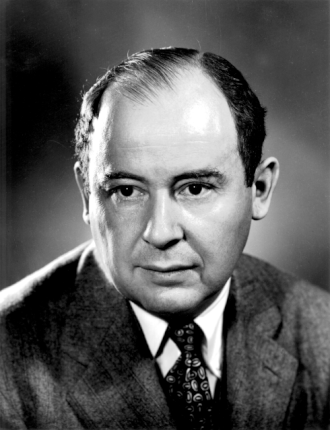 John von Neumann
"Children must be free to think in all directions irrespective of the peculiar ideas of parents who often seal their childrens minds with preconceived prejudices and false concepts of past generations. Unless we are very careful, very careful indeed, and very conscientious, there is still great danger that our children may turn out to be the same kind of people we are."